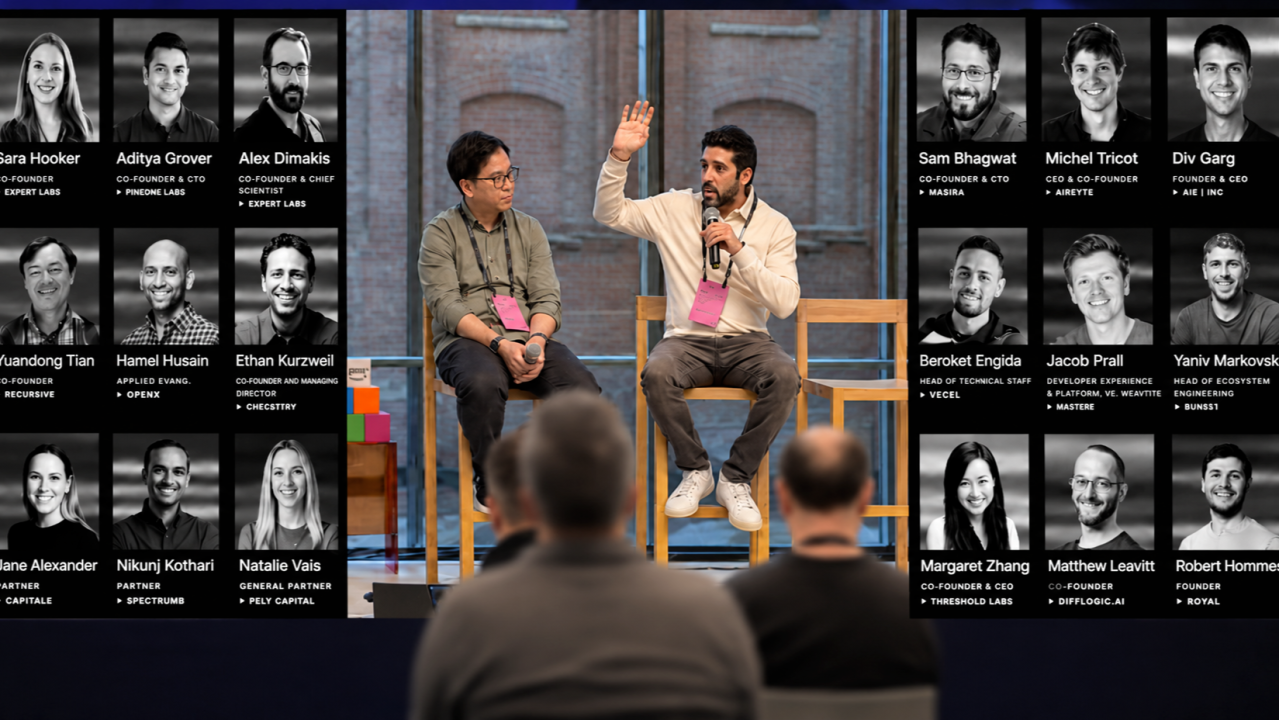
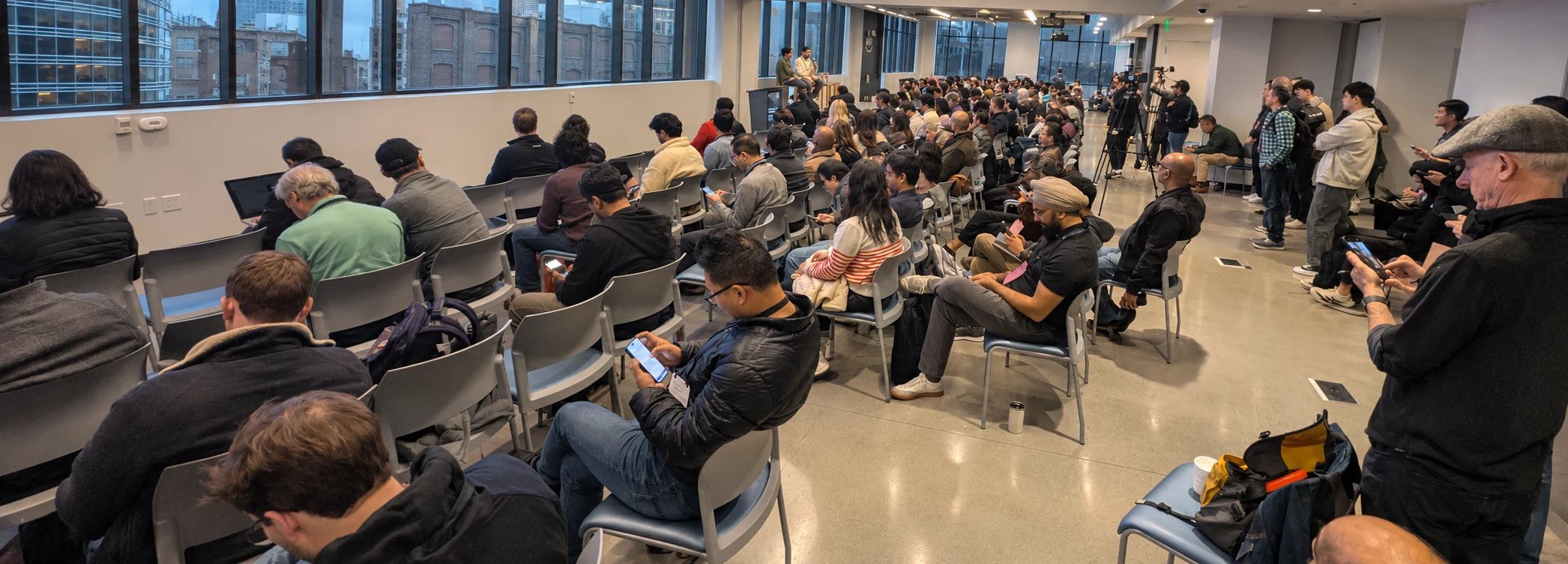
Black Friday is ten days out, and a fireside at yesterday’s Backprop Summit Amazon Web Services (AWS) Builder Loft, zeroed in on one big question: how many purchases will an agent actually complete? The summit itself was about frontier models and agentic infra. The room was packed elbow to elbow, standing room only, and nobody seemed to mind. Hundreds of engineers, researchers, founders and AI builders came to hear from people training frontier models and running agents in production, with everyone seeming to feel the same urgency.
Talks included panels on agent infrastructure and post-training, with speakers like Sara Hooker( adaption), Aditya Grover(Inception), Hamel Husain (OpenAI), Ted Xiao ( Prometheus) and Sam Bhagwat (Mastra), plus a tech VC panel and demos later in the day.
In the middle of all that, a slightly unplanned fireside turned to shopping. On stage were the event’s masterminds: Saroop Bharwani, whose company Senso was acquired by Zeta Global about six weeks ago, and Simon Tiu, who works deep in payments at VGS. One came from the discovery side of agentic commerce and the other from the payments side. Between them, the whole gamut from search to chargeback got covered, and the summary was candid: “We’re probably a step away from it really being reliable and safe.”

Author’s photo w/ screens removed
Discovery: the new SEO
Saroop said he spent the past six months at Senso on the GEO/AEO wave.
“GEO is effectively pushing content to your website that is purposely built for agents to discover and cite in the answer.”
Web search powers the answers in ChatGPT and Perplexity, and by his numbers the split is lopsided: roughly 15% of that content comes from brand-owned sites and 85% from publishers. Brands got serious fast. In his words, “they coined it ’the new SEO,’ and so that is the discovery layer.”
Then shopping agents like Muse and Instinct arrived. Simon put Muse’s launch around September 8, and Saroop described the enterprise reaction as a frenzy. Financial services, insurance, automotive and retail clients, he said, had all been pushing content to their sites. Once those agents began comparing prices across entire industries, and stories of malicious agents coming to websites without any sort of defense tactics started circulating, a split opened up inside companies. Saroop called it “a bit of a schizophrenia in the organization”: do we block our website, block the agents, or enable them? Later he broadened his take. Enterprises that are not AI-native, “the majority of the world,” do not know what to do, and “even the AI-natives are trying to figure this out.”
Merchants are configured against the traffic they want
Part of the problem is older than agents. Simon invested years ago in PerimeterX, a bot detection company, and has said the same thing ever since: merchant infra is not just unprepared for agentic traffic, it is actively configured against it. Most sites cannot tell a good bot from a bad one.
The answer on whether that is changing was candid. Saroop did not know yet, and suggested merchants follow their platforms. The ones on Shopify are “driven by what Shopify enables,” and the guess was that Shopify is already working on tools to detect these things. It is early days, and the infra “is just not built for this type of penetration.” The same gap shows up on the cyber side, where incidents had been landing almost daily this week.
“We’re not only seeing it on the shopping side, we’re seeing it on the cyber side. Every day over the last week there’s been some sort of incident that we’ve heard, including today. Apple, and, you know, name your… there’s been a couple today that have happened. It’s not a coincidence, right?”
Checkout: it works beautifully, and breaks the norms
Consumers do not care about payment rails. They want the flight booked or the coffee ordered. Instinct started with two payment options, Shop Pay and Stripe Link, and the Stripe Link path issued a one-time virtual card to buy on the person’s behalf. It “works beautifully,” and it also breaks a stack of ecommerce norms.
Chargebacks cannot work the usual way. The card statement shows Stripe as merchant of record, not Walmart or whoever the shopper actually paid. BIN sharing norms get bent, and a Mastercard customer can end up transacting on Visa rails, which does not delight Mastercard. None of that matters to the shopper, and all of it matters for security and fraud. People pay for liability coverage and sit under KYC rules, and now KYA, Know Your Agent, is joining the list.
Liability: the old rules still point at the merchant
Simon laid out who pays when an agent buys the wrong thing. By default the issuing bank takes the liability, he explained, but issuers built layers of authentication that shift it back to the merchant, and the merchant “can’t really fight back.” Many are mom-and-pop stores.
“At the end of the day, I think the merchants will probably hold liability.”
That is the reason VGS is focused on getting merchants ready to accept agentic transactions that fit network rules. The standards groups that adjudicate disputes and chargebacks will have to adapt, in more ways than a few. Scoped, verifiable credentials look like the practical path: a merchant can only say yes to a machine if the token in front of it carries proof of what it is allowed to do.
The long tail pays first
Simon had a test anyone can try. Try asking an agent to buy something from Safeway and it will usually route through Instacart or DoorDash. Nine times out of ten, maybe ten out of ten. Agents are persistent and smart, and the aggregators already have the infrastructure to let the transaction through.
That makes the net beneficiaries, for now, tech-forward aggregators. For the rest it is “really harmful almost to the long tail of merchants that aren’t prepared.” They lose volume and risk being disintermediated by the agent interface. Being agent-ready may turn out to be this cycle’s version of being mobile-ready, with one difference in pacing. It took about ten years for a third of ecommerce to move to mobile. Everyone already carries the device and has the connection this time, so the bet was that agents move “much faster.”
What to watch
Discovery will probably happen first. The number to watch is how many Black Friday and Cyber Monday transactions are actually completed by an agent, and my guess that industry is still bit in a hype cycle. OpenAI also announced a native wallet experience, so agents can now buy with a wallet of their own. (my reflections here)
The more challenging question is what big companies should do. Consumer demand is there, and the experience will only get better. As Saroop said, most large orgs, though, are not AI-native, and they do not know whether to block or enable. Each vertical has its own nuances, from insurance to automotive to telecom to retail, which led to the open question of the afternoon: can the frontier labs solve all of that, or does it become vertical work for builders?
Which layer breaks first this season: discovery, checkout, or the dispute after? Curious what builders and merchants are noticing.
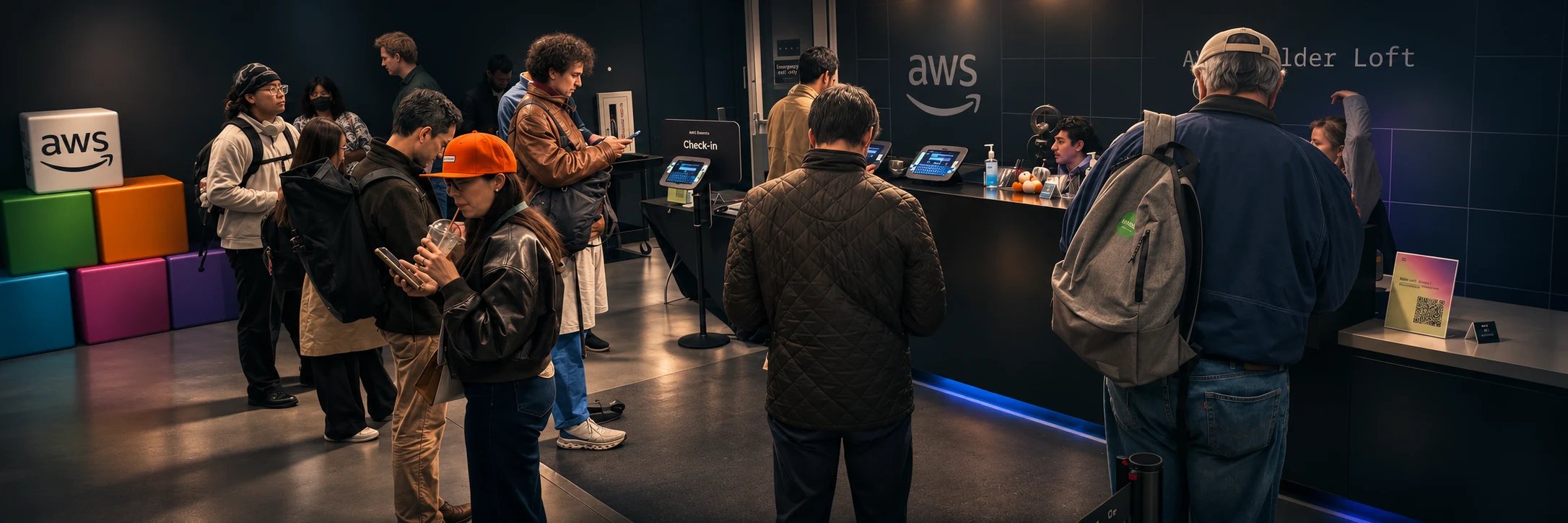
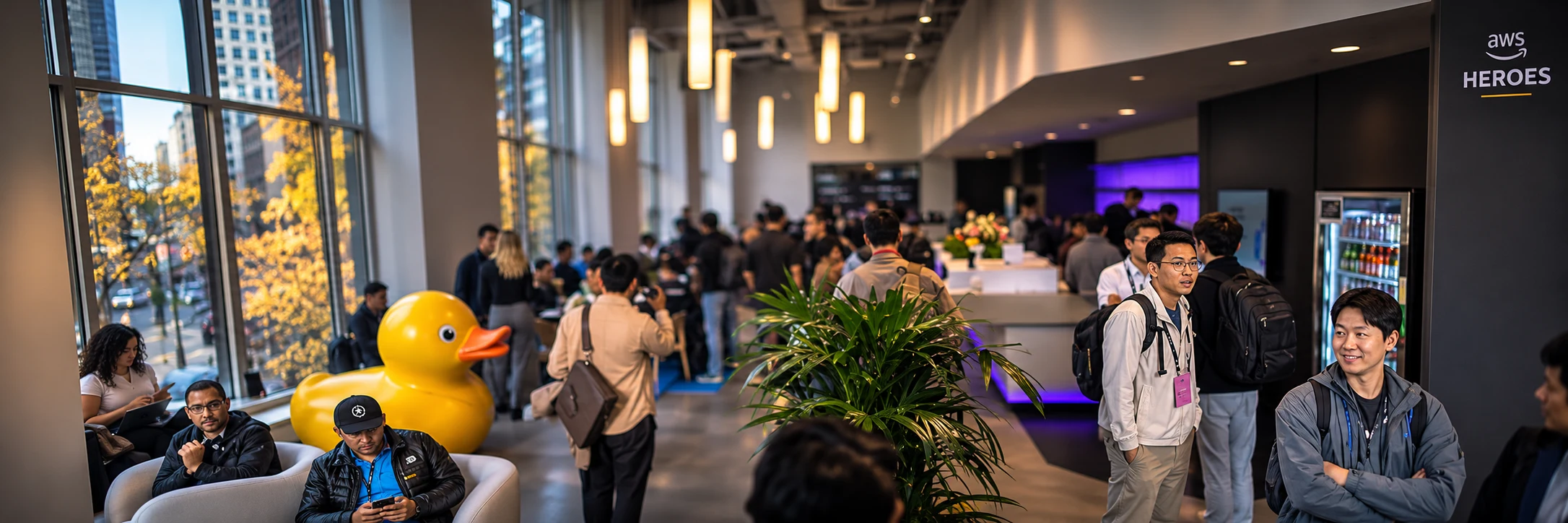
Thanks to the speakers, tokens& and AWS Builder Loft teams for such a memorable event!
bsky.app/profile/schwentker.sandboxlabs.ai/post/3n2mvscevgc2d
twitter.com/schwentker/status/2123224874504401371