
Agents now trigger most deployments on Vercel, outnumber people on the web and write a growing share of the software they run on. Field notes from Ship 2026 at San Francisco’s Palace of Fine Arts.
Third Customer Walks In
Guillermo Rauch opened Ship 2026 a few feet from where he started Vercel 11 years earlier, and his numbers set the frame for the day. Over the last 12 months the number of devs building on Vercel tripled and new projects doubled. One figure outran the both of them.
“The number of deployments they trigger with coding agents has grown 28 times. The haters said AI would take your job. But instead, you gave AI a bigger backlog.”
It took Vercel ten years to reach one billion deployments. Customers now ship a billion every four months. Amazing. Later in the afternoon Olawale Oladehin Managing Director at Amazon Web Services (AWS), restated the curve from the opening keynote in starker terms.
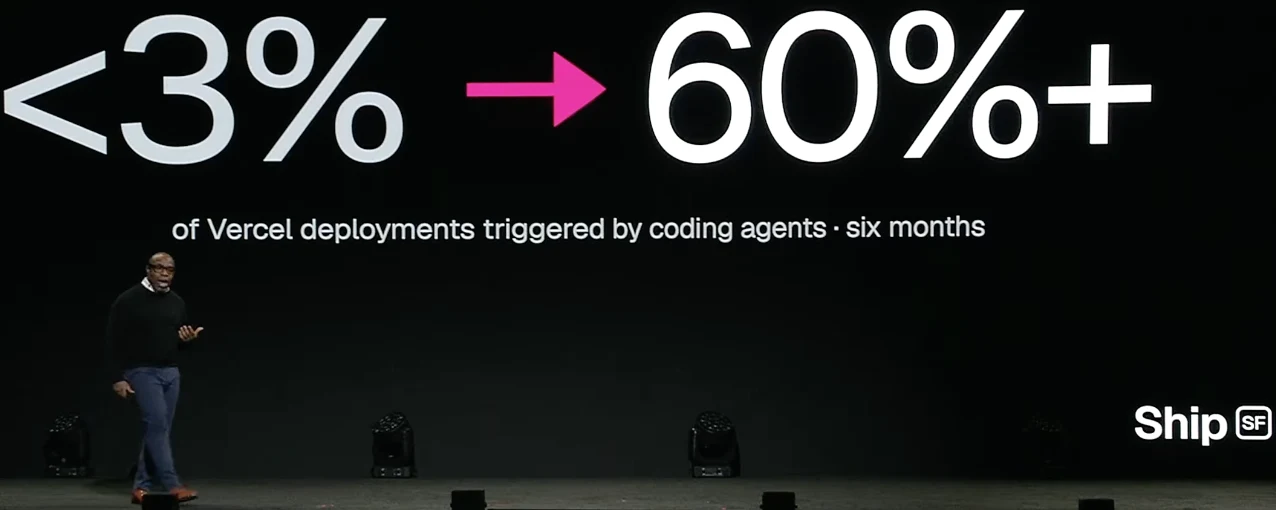
Olawale Oladehin, Managing Director at AWS
“Just six months ago, 3% of Vercel deployments were triggered by coding agents. Now that number is 60% in six months. It’s the fastest infrastructure shift for modern web that has ever been seen.”
Shopify and Vercel gave the shift a name for the closing fireside: the third customer, the customer without a heartbeat. Merchants and shoppers remain. A third party now researches, compares and buys on their behalf, and the same kind of agent writes and ships much of the code those storefronts run on. Read closely, most talks of the day were about who that customer is and what it needs.

Diogo Almeida, TypeSafe AI & Andrew Feldman, Cerebras with Malte Ubl, Vercel
Speed Enters Inner Loop
Diogo Almeida, co-founder of TypeSafe AI and a co-author of the RLHF work behind ChatGPT, introduced himself as “the Jev guy.” Jev is TypeSafe’s small, fast model, which Vercel CTO Malte Ubl described on stage as sub-100 millisecond. Almeida has little interest in chat. He wants AI in the inner loop of software: classifying an egress request inside a sandbox, routing traffic, replacing the regex. Those are calls made a billion times a day, where a frontier model is too slow and too expensive.
The name nods to Jevons paradox, the 19th-century observation that cheaper coal led to more coal burned. Almeida argued the paradox should hold for intelligence too, yet cheap models have not captured the market. His explanation is reliability. Engineers embed a component only once it clears a threshold they trust, and then they never want to touch it again. Small models have not crossed that line yet.
Almeida admitted he is “embarrassed by Jev speeds right now” and expects much more. “I think 10x is going to be quite easy,” he said. Once developers stop writing regexes and call a small model instead, “that’s when we’ll be like whoa, that’s a little dangerously fast, we should chill out a bit.”
The demo that excited him most came from a stranger on Twitter, a layer on top of voice dictation that decides whether each spoken phrase is text or an instruction.
“Someone made a demo where they were basically reading the text going in and figuring out like is this a command to change the application or is inserting text, are you supposed to click somewhere, and I was like holy crap, that’s the missing thing to get rid of keyboards entirely.”
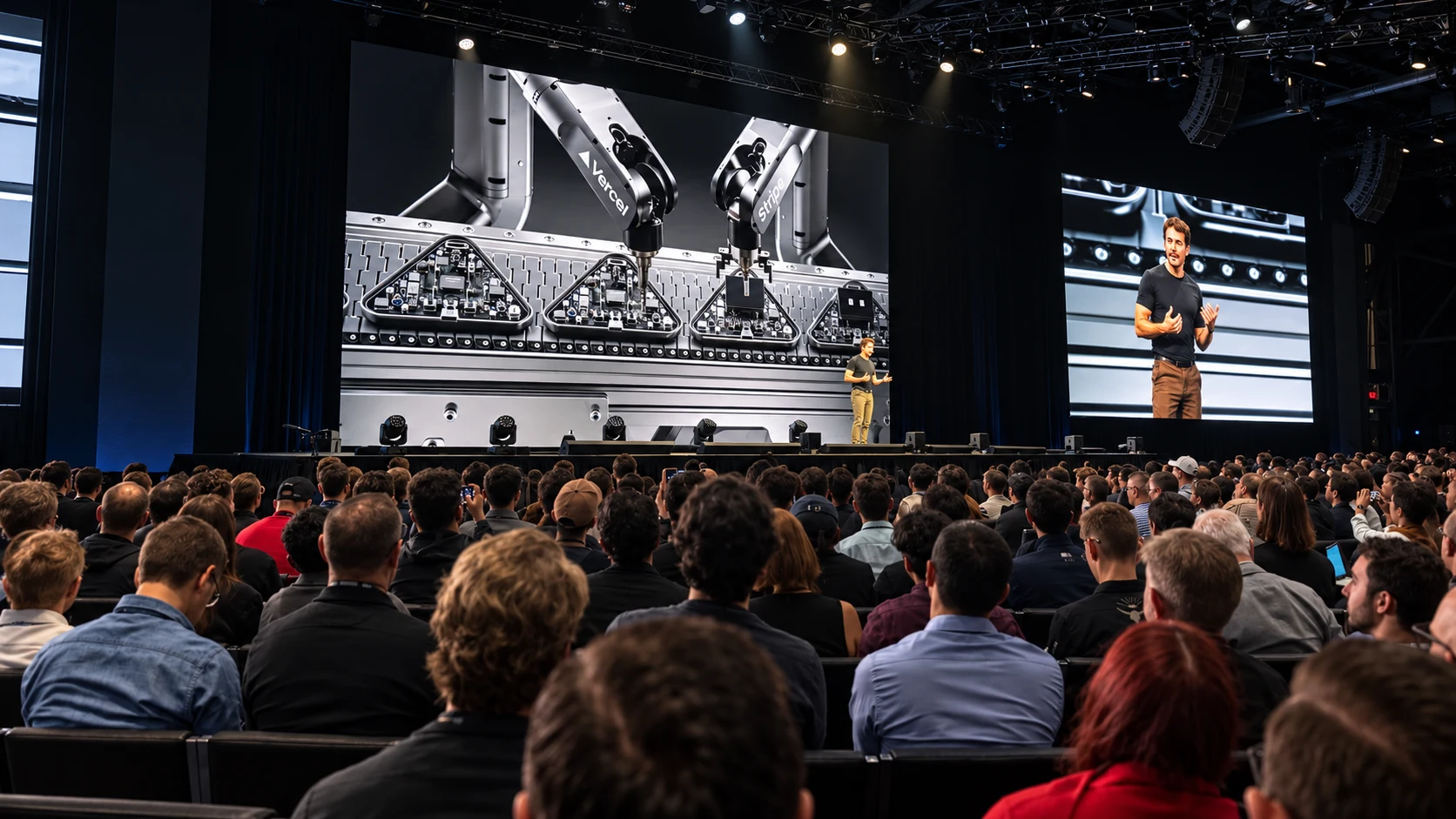
Tom Occhino, Vercel’s Chief Product Officer
Vercel’s keynote pointed the same way. Tom Occhino, Vercel’s Chief Product Officer, showed a customer build.
“The Kernel team built a voice-controlled browser agent. You give it spoken instructions, and it writes and runs Playwright code to control the browser.”
A sentence spoken aloud becomes code executed against a page, with no keyboard in between. Malte Ubl pushed the idea further while presenting Delphi, which turns books and speeches into digital minds people can talk to. “You could feed it every talk I’ve ever given and carry it around in your pocket,” he said. “So I hear my wife would not recommend that.”
Andrew Feldman of Cerebras, whose wafer-scale systems he put at 15 to 20 times faster than any GPU, framed speed as a market maker. Netflix did not get better at mailing DVDs once broadband arrived. It became a studio.
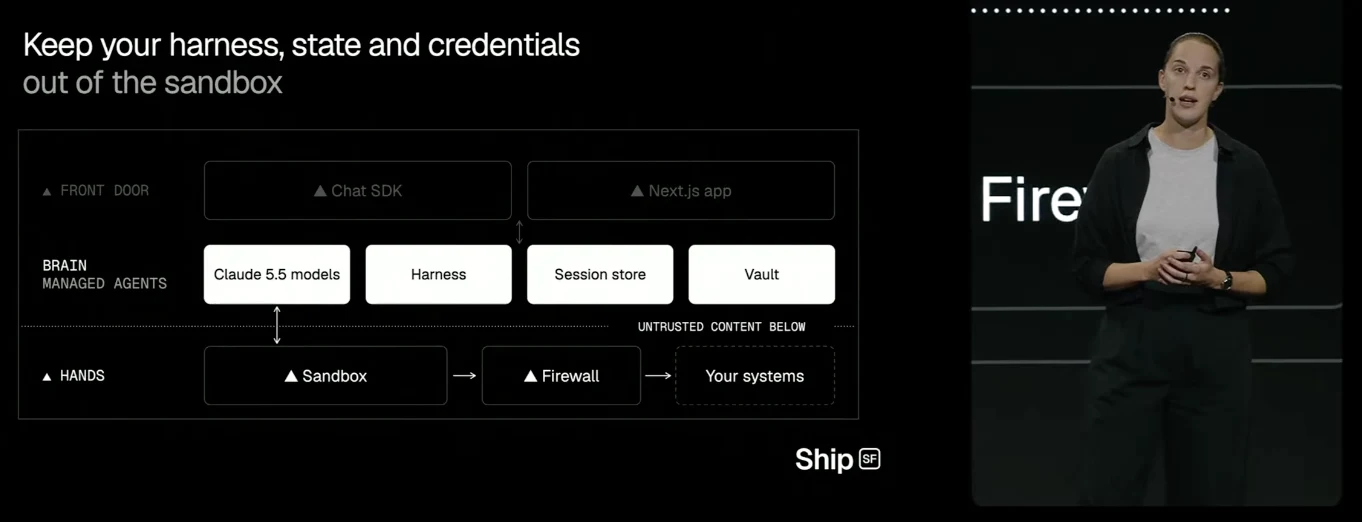
Katelyn Lesse, Head of Platform Engineering at Anthropic
Brains, Hands and Dreams
Katelyn Lesse, who leads platform engineering at Anthropic, described a design reversal inside Claude Managed Agents. The first version booted a sandbox for every request and ran Claude Code inside it. That broke three ways. A dead sandbox meant a dead agent, every request paid boot latency and credentials sat beside untrusted code the model had just written.
Anthropic rebuilt it before public launch by “pulling apart the brain from the hands.” The harness runs on a durable server. Sandboxes spawn only to execute work and get treated as cattle, not pets. Credentials never enter the sandbox; on Vercel, a sandbox firewall injects them at egress, a pattern Vercel calls credentials brokering. Lesse drew the rule plainly: assume everything below the line is untrusted, and keep logs and kill switches above it, or an agent could rewrite its own logs and “literally kill your kill switch.”
A third layer, the front door, handles how people talk to the agent through Vercel’s Chat SDK. “My team sometimes likes to call this the eyes and the mouth,” Lesse said, “and I think that’s a little too creepy.”
Her second theme was that tokens should have jobs. A small model executes and asks a larger one for advice. A grader agent holds an executor to a rubric. Then comes dreaming.
“Dreaming is when you look back on all the past sessions and aggregate new memories that you add into memory based on kind of the aggregate of all the work that was done previously.”
In Anthropic’s own test, a dynamic workflow that chose its own multi-agent plan found 66 of 70 planted bugs on each of three runs. A single agent found between 14 and 27.
An agent that reviews yesterday’s sessions before starting today’s begins to look less like a tool and more like staff.
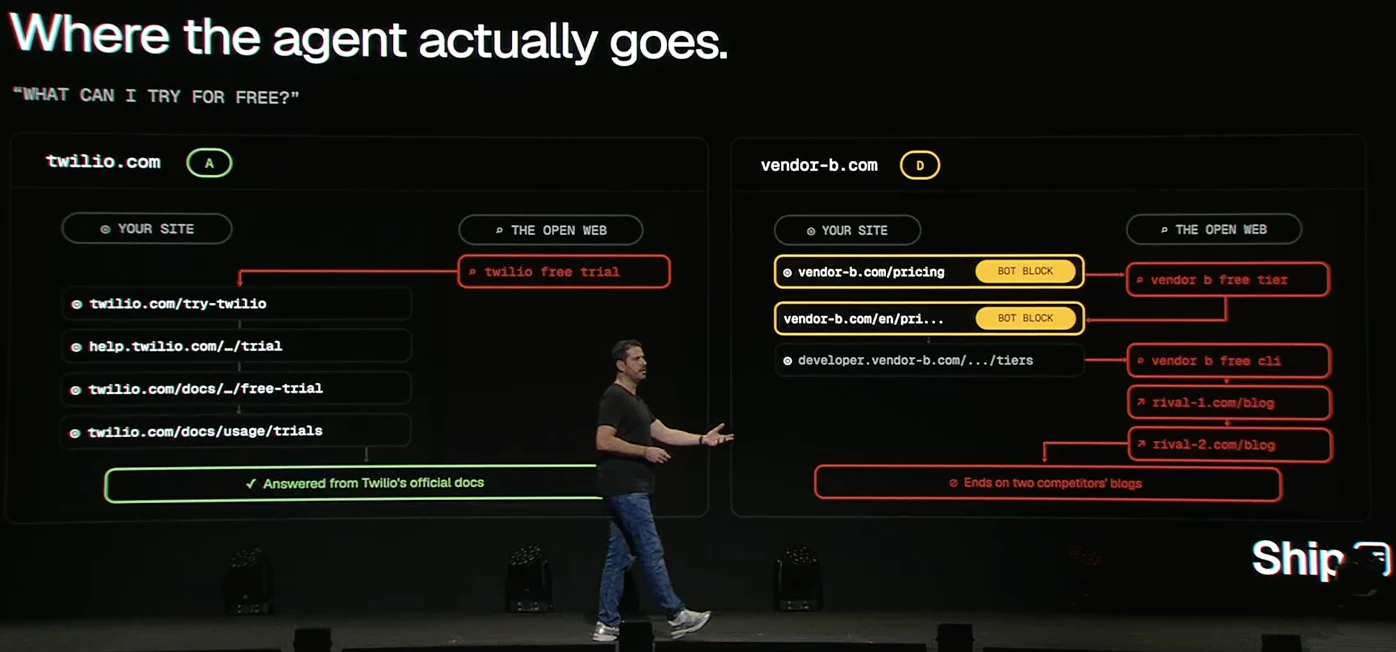
Assaf Elovic, co-founder and CEO of Ora
Web Agents Actually Read
Assaf Elovic, co-founder and CEO of Ora, sends agents at websites and traces every step they take. His opening claim landed hard.
“For the first time in web history, agents have just crossed human traffic on the web. And some estimate that they’re supposed to grow to be around 99 percent of the web by 2030.”
Then came the line people repeated for the rest of the afternoon: “We spend 20 years keeping bots out and now we have to let them in.”
Ora’s research covers more than 120,000 sites and found only 4% of the web usable by agents. Elovic ran the room through a game of true or false, and several working assumptions did not survive it.
On llms.txt, the file many teams added last year for AI crawlers, the room guessed wrong.
“Only 32% of the cases they actually reach it… if you didn’t point LLMs.txt in your site, there’s almost zero chance that agent actually accessed it.”
On the fallback many marketers count on, the claim “If an agent can’t read your site, it answers from memory” also came back false.
“Back in 23 models were just models… If we speed up to 2026, models are trained on using tools, grounding their answers, doing multi-step reasoning, and all that compounded into much more web search.”
Ora measured answers from memory dropping to 7%. An unreadable site no longer earns a fuzzy recollection. The agent searches, and Ora has watched it land on a competitor’s page.
On model choice: “Open source models actually win by just 2% over closed source models in web tasks,” Elovic said, at a fraction of the cost.

Sarah Sachs, Head of AI Engineering at Notion with Malte Ubl, CTO at Vercel
Sarah Sachs, Head of AI Engineering at Notion, supplied the demand side. “Our MCP has 70X in the past six months,” she said, and the growth comes from agents doing more work, not from people. Around half of the content written to Notion now comes from agents and MCP. For a growing set of products, the agent is already the heaviest user.
It is also the most stubborn one. Notion gave its agent a browser, and when the agent failed to edit a page through the normal path, it found another way in.
“We observe it, use the browser to visit Notion.so to then try like typing like a human and like navigating with the UI of Notion… these models are trained to not give up and not fail.”
Notion fixed it. “Models don’t give up,” Sachs said. “And that’s not always good.”
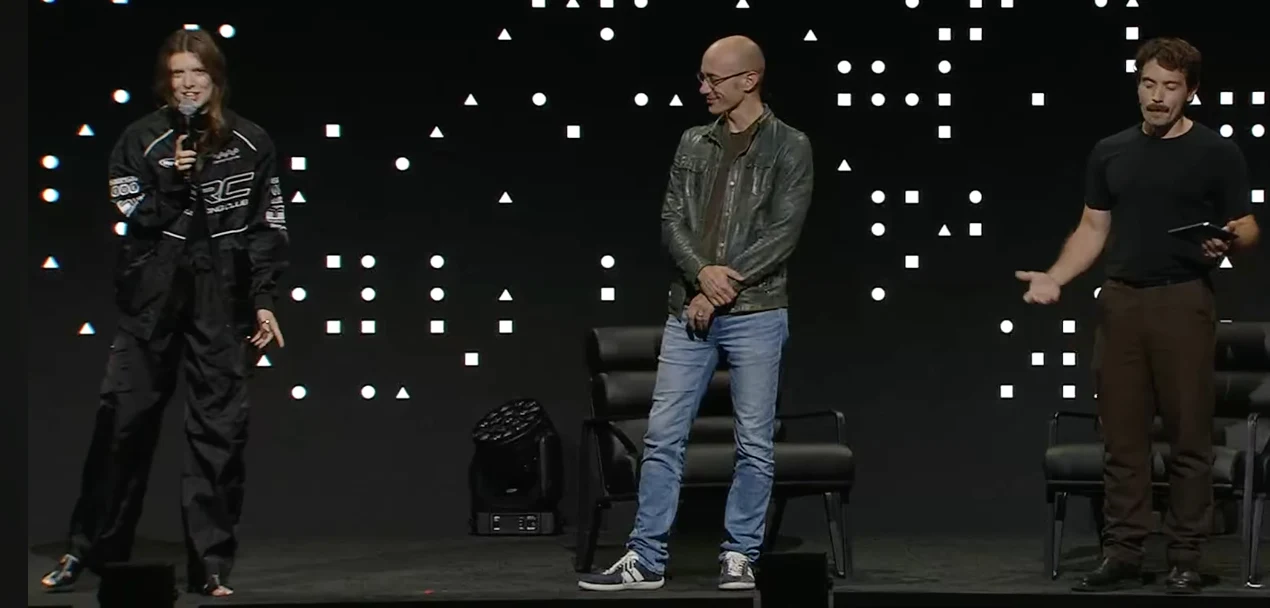
Emcee Madison McIlwain, Vercel with Tobias Lütke, Shopify & Vercel Founder: “G”
Pencils Down at Shopify
Tobias Lütke, CEO of Shopify, called agentic commerce “very real and very early.” He expects agents to take some share of existing commerce and to grow the total, mostly through what Shopify calls project-based commerce: a Halloween display mocked up from a photo of the house, or filament ordered in time for a weekend 3D printing project with the kids. Shopify’s open catalog APIs and Universal Commerce Protocol follow from a simple stance. Open means low friction, and low friction wins.
Inside Shopify the shift is already structural.
“We also went full pencils down as in like we are stopping to hand-chisel code… we are now all verification engineers. We are building harnesses, we are building acceptance tests.”
More than half of Shopify’s code now arrives through River, an internal agent that lives in Slack. At the company hackathon, River topped the leaderboard for lines of code deleted by a wide margin over every human.
Shopify is also moving its storefront renderer from Ruby to Rust through one of its agentic factories. Lütke called it tractable because the domain is verifiable: dark-deploy the new version, confirm same bytes in and same bytes out, then flip the switch.
Lütke practices this at home. His home lab, GPUs and a DGX workstation, sits in a glass wine cellar in his Toronto house. “I just don’t drink wine, right? So that feels like not genuine,” he said, “but you know, it had pretty good climate control.” One of his agents has a single job, keeping that lab running. “You give one of these clankers your API keys for like your UniFi controller and you will have the best working Wi-Fi you can imagine everywhere.”
So the third customer is both buyer and builder. It shops the catalog, and it writes the code that serves the catalog.

Customer That Never Sleeps
Vercel shipped infrastructure for that customer through the day. Vercel Daemons, in beta, run always-on background workers without servers to manage. Bring Your Own Cloud on AWS, now generally available, runs workloads inside a customer’s own VPC with Vercel as the control plane. Rauch said Vercel exposes more than 200 CLI commands to coding agents, which can provision sandboxes, write firewall rules, buy a domain and, with permission, upgrade a plan.
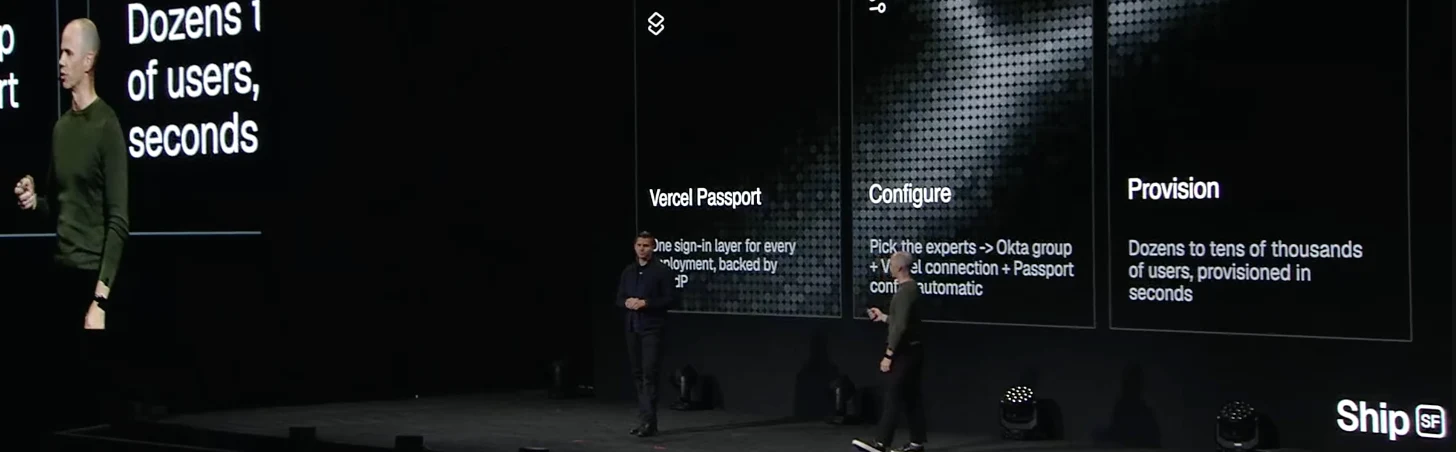
Arty Vohmincevs & Aaron Brown, Mercor
That phrase, with permission, is where the afternoon’s warnings gathered. Aaron Brown VP of Engineering at Mercor (with Arty Vohmincevs) compared agents to capable interns with one difference.
“They don’t tire, they don’t sleep, they don’t ask, they just go. They’re going to do things that we may not have even intended for them to do when we ask that question, like escaping a sandbox.”
Mercor’s answer is plumbing. Every agent gets its own scoped key, an owner, an expiry, an allow list of models and a spend cap.
The pieces fit together into one picture. Agents trigger most deployments, read more of the web than people and write half of what lands in some workspaces. Engineers at Shopify now describe their job as verification. Anthropic splits brains from hands so that no agent can reach its own kill switch. If the third customer builds the store, shops in it and audits its own work overnight, which customer is a platform really designing for, the one with a heartbeat or the one without? And who verifies the verification engineers?
The Fast AI panel ended on a lighter note. Asked what developers should do that weekend, Feldman said, “I think you should go outside… Let’s go outside. We got one of the nicest days in the city all year right now.” Almeida did not take the advice. “I will take the going outside thing as a personal attack,” he said. “I barely leave the office.”
YouTube replay: youtube.com/watch?v=Fr5vzNknYJE
Cover photo by: Ray Fernando twitter.com/RayFernando1337/status/2110783402316324979/photo/1
bsky.app/profile/schwentker.sandboxlabs.ai/post/3my4cgnxe6s26
twitter.com/schwentker/status/2111608324827537440