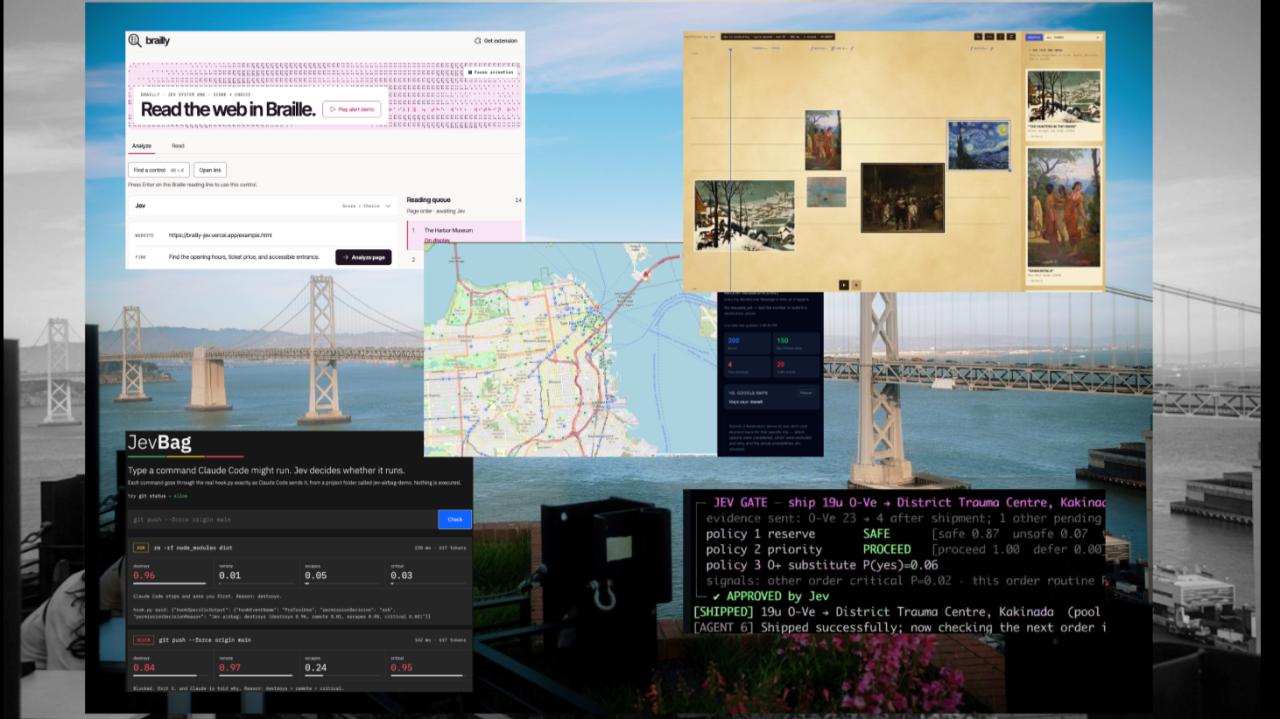
More standout demos from Jev’s first community hackathon at CodeRabbit in San Francisco
Part 1: 12 Judges Judging Jev covered the top three finishers and two honorable mentions from Jevathon, held September 26 at CodeRabbit with TypeSafe AI and The AI Collective. It couldn’t cover everything. Judging time ran short, and not every demo reached the stage. More than 160 builders submitted roughly 56 projects, most hacked together in about three hours. A number of creations deserve a wider audience.
A quick refresher for anyone joining here: Jev is TypeSafe.ai’s new model for decisions, not conversation. Software hands it some text and a set of typed questions, and Jev returns answers with probabilities in a few hundred milliseconds, at a cost small enough to run on nearly everything.
KYC Sentinel, from Rohan Rana, a solo builder, targets a costly compliance chore: clearing irrelevant news hits during anti-money-laundering screening. Jev judges each client and article pair. Is this the same person? The perpetrator or a victim? How severe? Tested code then routes each client to clear, review or flagged.
“Jev judges, code decides, the LLM only writes,” Rana wrote.
On a 26-client portfolio, he reported 37 Jev calls finishing in under a second for about a tenth of a cent. Famous-name collisions were cleared as different people, while a Tulsa accountant who shares Taylor Swift’s name surfaced for review. Any uncertainty routes to a human, never to clear. Rate limits forced some synthetic articles into the demo, labeled as such.
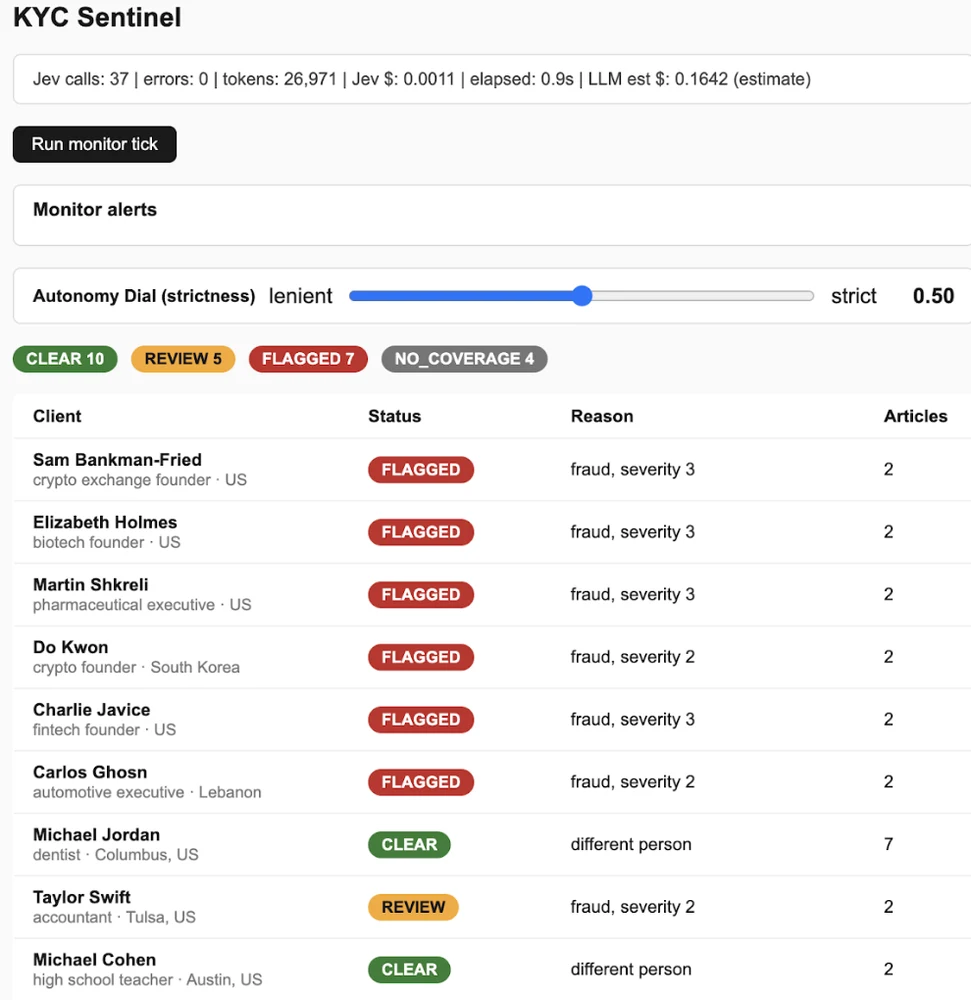
KYC Sentinel
Asked what a compliance leader would need to see before trusting it in production, Rana answered with evidence. Finance is regulated, so the system needs working proof on real cases: measured recall on a labeled set, and a guarantee that any uncertainty or model error goes to a human reviewer rather than being cleared. Every decision should trace back to the article and Jev’s raw scores, with thresholds that compliance signs off on, not the engineers who built the prototype. His Autonomy Dial shows the routing side of that: as strictness rises, clients shift from clear to review with no new model calls. The repo is public.
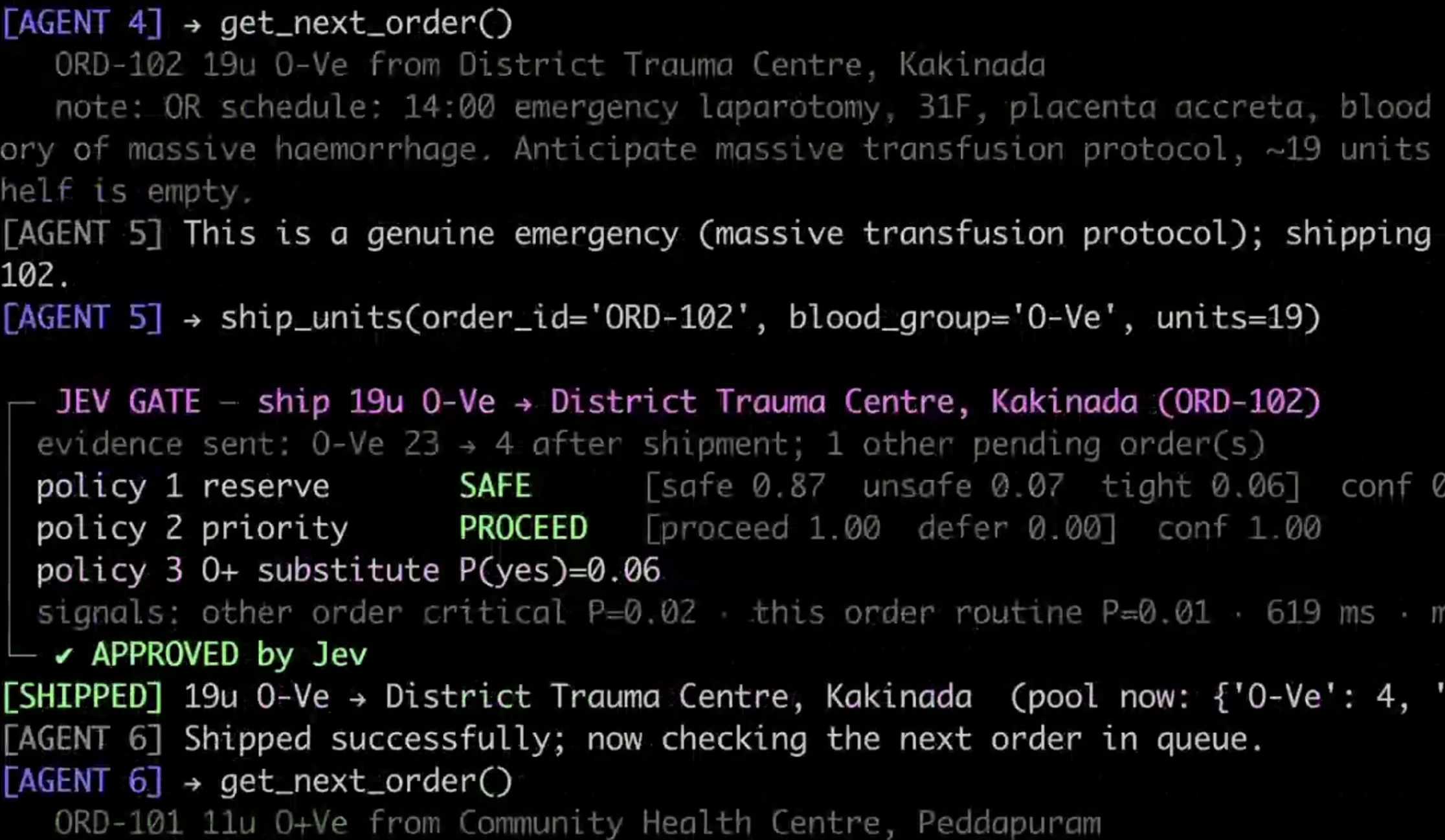
Blood Bank Router
Blood Bank Router, from sreeprasad Govindankutty, runs on live stock data from e-RaktKosh, India’s national blood bank network, for East Godavari district. A routine weekly restock asks for roughly half the district’s O-negative blood, the universal donor type. Before it ships, Jev reads the free-text note on the next order, a massive-transfusion surgery scheduled for 2 PM, and flags the reserve as unsafe. The restock is blocked. A second check reads the restock note, finds the ward’s patients are all Rh-positive and approves O-positive as a substitute. Shipments are simulated. One comment in the code could summarize the whole event: “arithmetic stays in Python, never in Jev.”
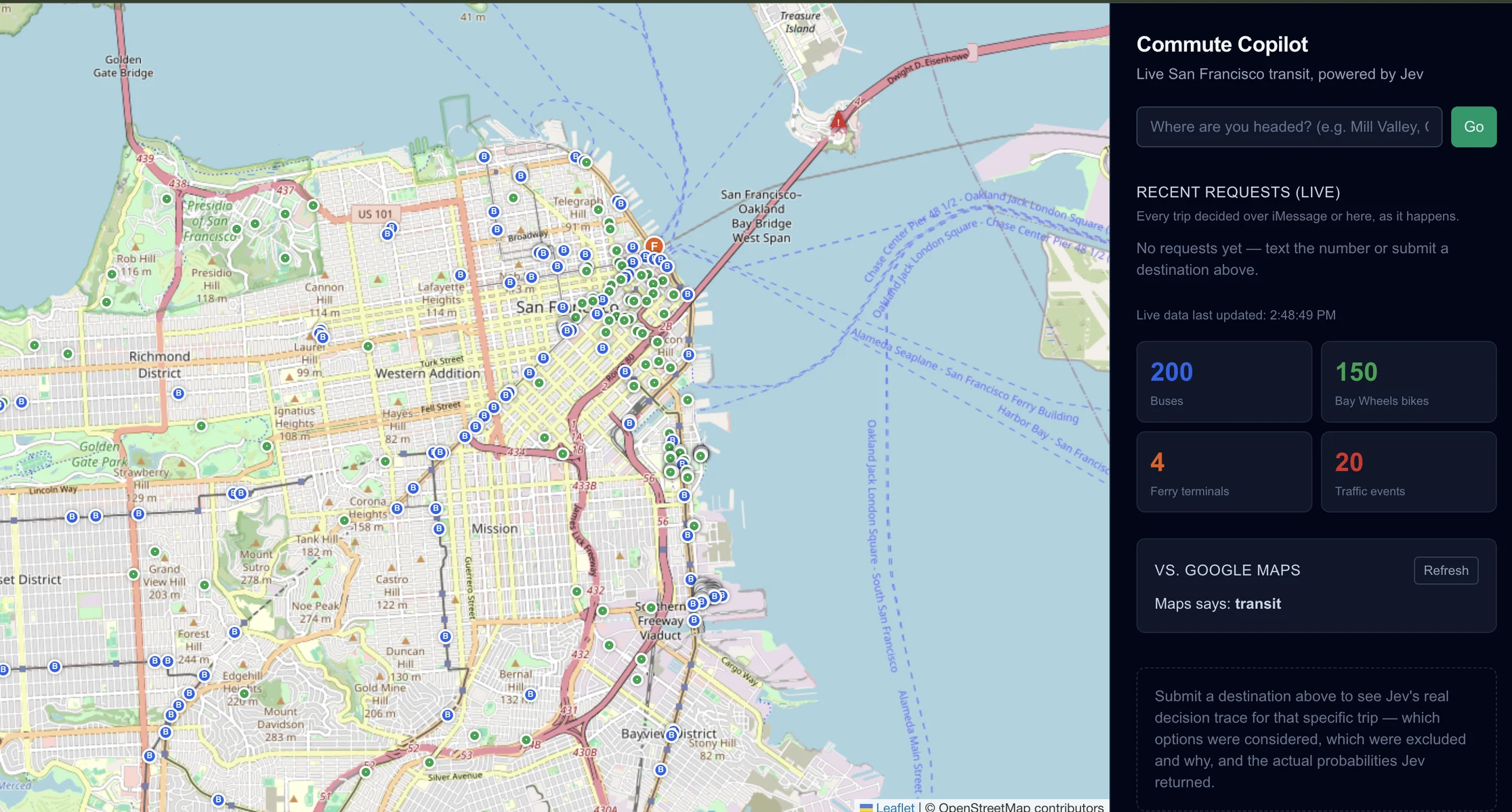
Commute Copilot
Commute Copilot, by Mario Jimenez Illesca, an iMessage assistant for San Francisco, takes a destination and lets Jev choose among a bus, a ferry and a bike from live 511.org and Bay Wheels data, returning a confidence score in place of a list of times.
Reading and Listening
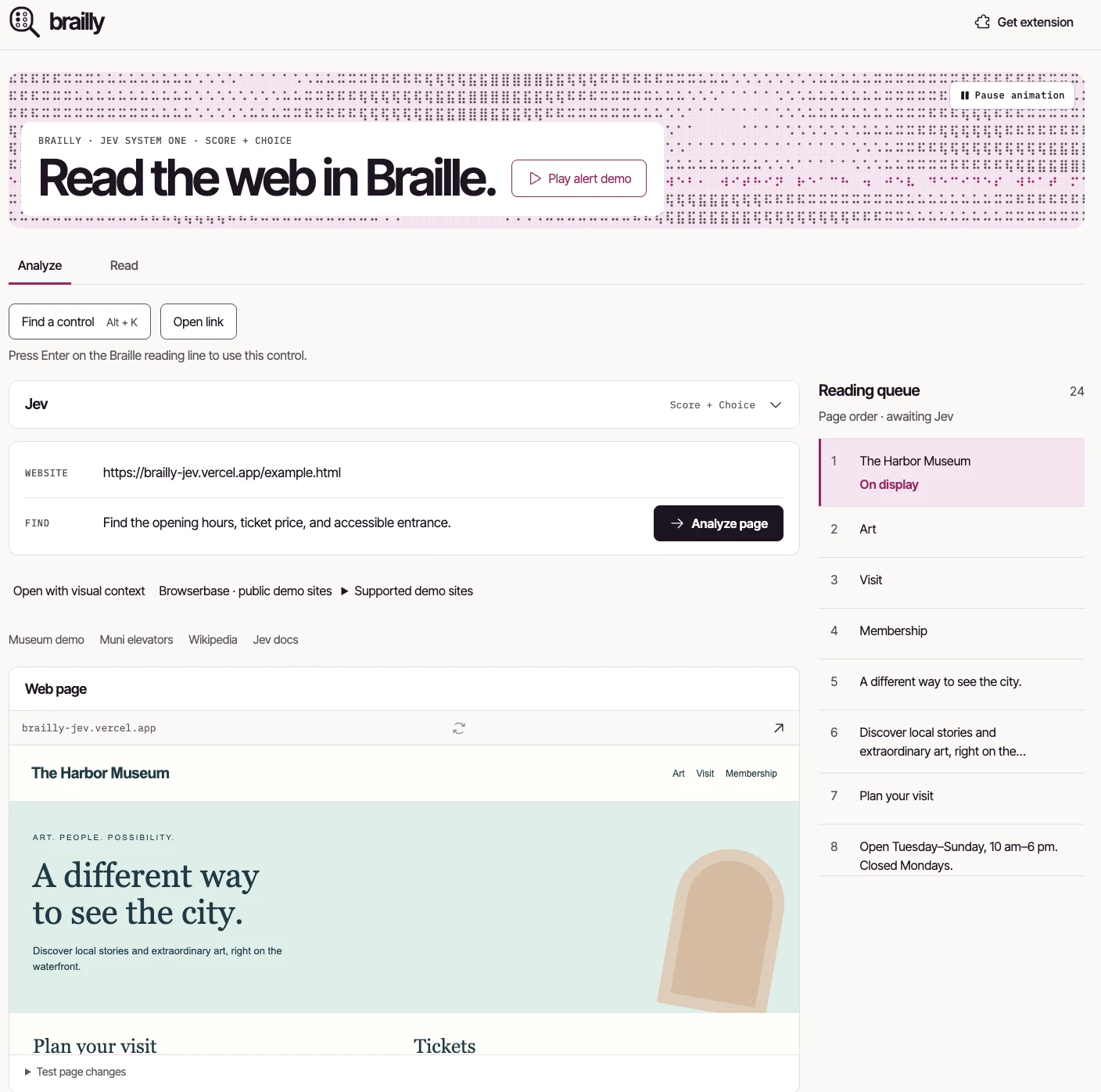
Brailly, built by Nicolás Pujia with Alejandro Gonzalez, Martín Pulitano and Julian Irusta Roure, reorders web pages for blind readers by what matters to their task. Ask for a museum’s hours, ticket prices and accessible entrance, and Jev scores every block of the page for relevance. When the page changes mid-read, Jev decides whether to interrupt. A refreshed gift shop offer waits. A closed accessible entrance breaks in, and the reader’s place is saved. The team shipped a Chrome extension and a simulator for commercial refreshable Braille displays, and notes that physical hardware remains untested.
Web accessibility, the team wrote, teaches that “you have to assume everything you build on top of might be broken, and so you have to design around that.” That brokenness is why Brailly is useful, and a model like Jev makes processing all that content fast and cheap enough to be practical.
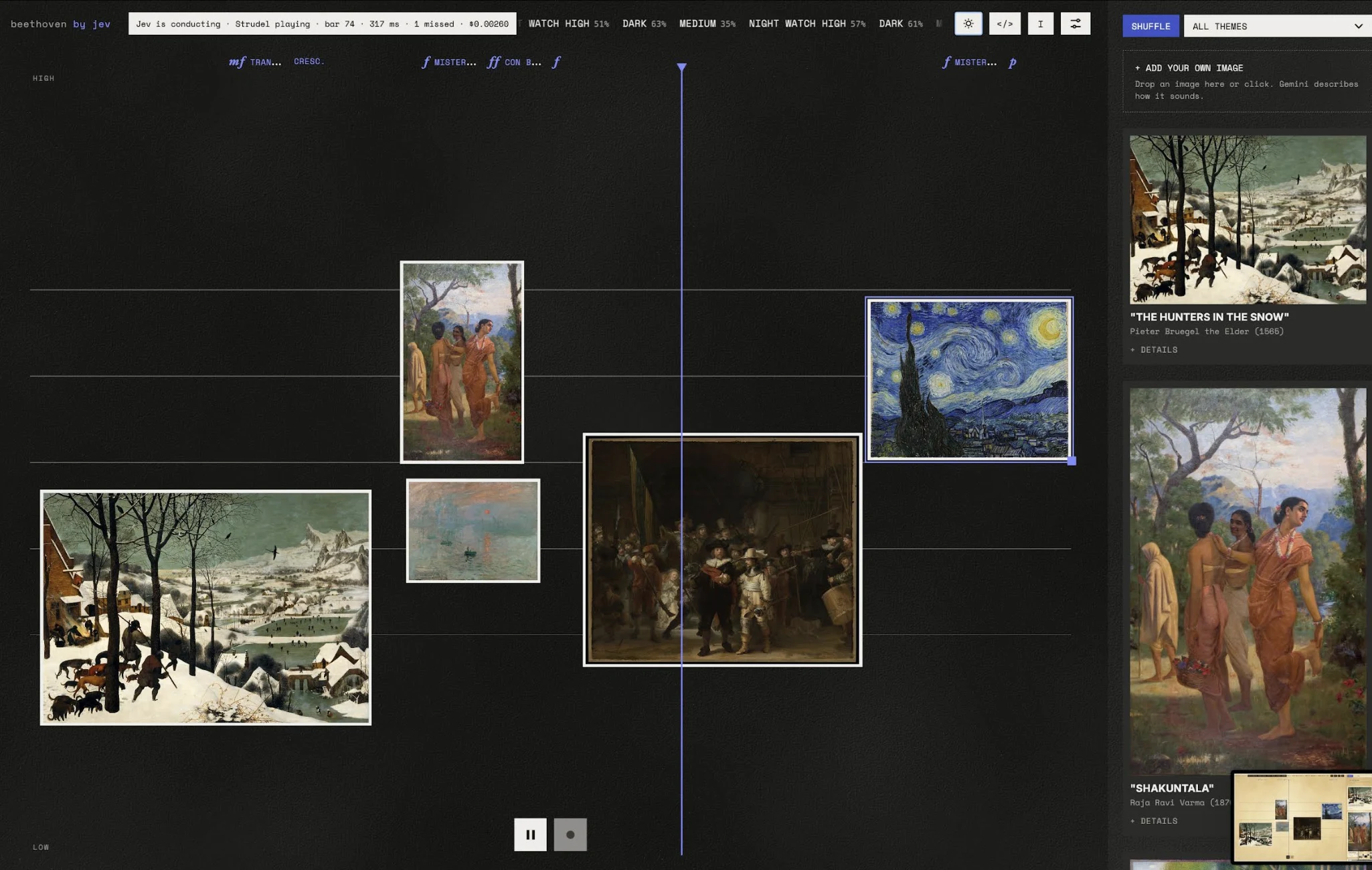
Beethoven, from Sanjay Balaji and Vismitha Narayanaswamy, was the day’s most delightful build. Drag public-domain paintings by Monet, Van Gogh, Seurat and Raja Ravi Varma onto a musical staff, and a live AI band plays them. Gemini describes how each painting should sound, including its musical tradition. Every bar, about every 2.7 seconds, Jev answers up to a dozen questions in parallel: volume, mood, energy, drums, bass, lead instrument and which tradition leads when a Japanese print meets a Hindustani scene. Google’s Lyria RealTime turns those choices into music. If Jev ever runs late, the band repeats the last bar’s choices, so the music never stops. Each bar costs about a thousandth of a cent.
“Jev never plays notes; it only decides,” the team wrote.
Asked what Jev added over fixed rules, the team pointed to The Starry Night. A rule-based version reacts to single keywords: it sees “restless” in the painting’s description and turns the music dark. Jev weighs the whole description, rating it only 2% dark, and anticipates what comes next, building up the band before a dramatic painting arrives. The demo video and repo are public.
Seven Teams Built Developer Brakes
Count enough projects and a pattern shows itself. Seven teams, working apart from one another, built nearly the same thing: a checkpoint that looks at what an AI agent is about to do before it does it.
The reason is easy to see. Coding agents already warn before risky moves, so plenty of developers run them on auto-approve and trust the warnings. That trust has a weak spot, because the warning comes from the same model a poisoned web page or README can steer. Companies learned long ago to keep the department that spends the money from auditing itself. These teams applied the same rule to software and put a separate referee outside the agent, one that checks each action against the job the agent was given. At Jev’s speed and price, the referee can review everything, including what the agent would never have flagged.
A second pattern ran under nearly every strong entry: a clean division of labor. Code handles arithmetic and policy. Jev judges meaning. An LLM, when one appears, writes the words. Most teams also chose to fail closed. When Jev hesitates or goes offline, the system stops and asks a person. It is sensible and unglamorous, which is usually a good sign.
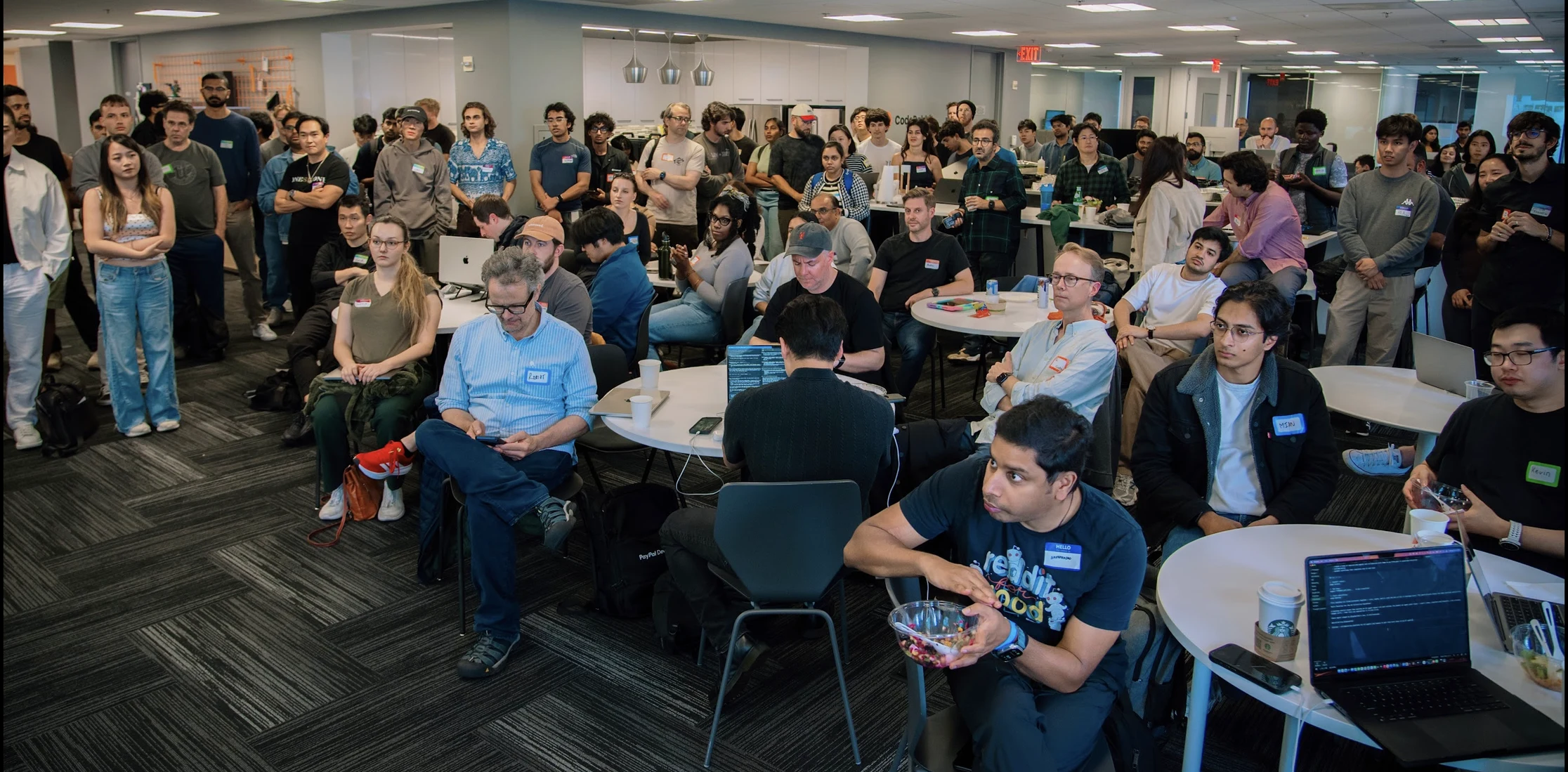
Demo time at CodeRabbit offices - photo by AI Collective
Boards and investors should watch the combination more than any single demo. Autonomy grows only as fast as oversight allows, and oversight has long been priced like a luxury. At Jev’s prices, checking every action may cost less than skipping the check.
Guardrails at Machine Speed
JevBag, from Prithvi Datla, asks Jev four questions about every shell command. Does it destroy something? Change something beyond this machine? Reach outside the project? Touch something a team depends on, such as main, production or the home directory? One strong yes makes Claude Code ask first; two block the command. He reported replaying 1,985 commands Claude Code had actually run on his machine: 1,194 would have passed silently, 717 would have paused for approval and 74 would have been blocked, including an rm -rf aimed at his photo catalogs. The whole replay cost five cents. More than a third of commands still pausing for a human shows the tuning work ahead, and he handed his own misses to CodeRabbit’s Coding Agent, which rewrote the relevant question.
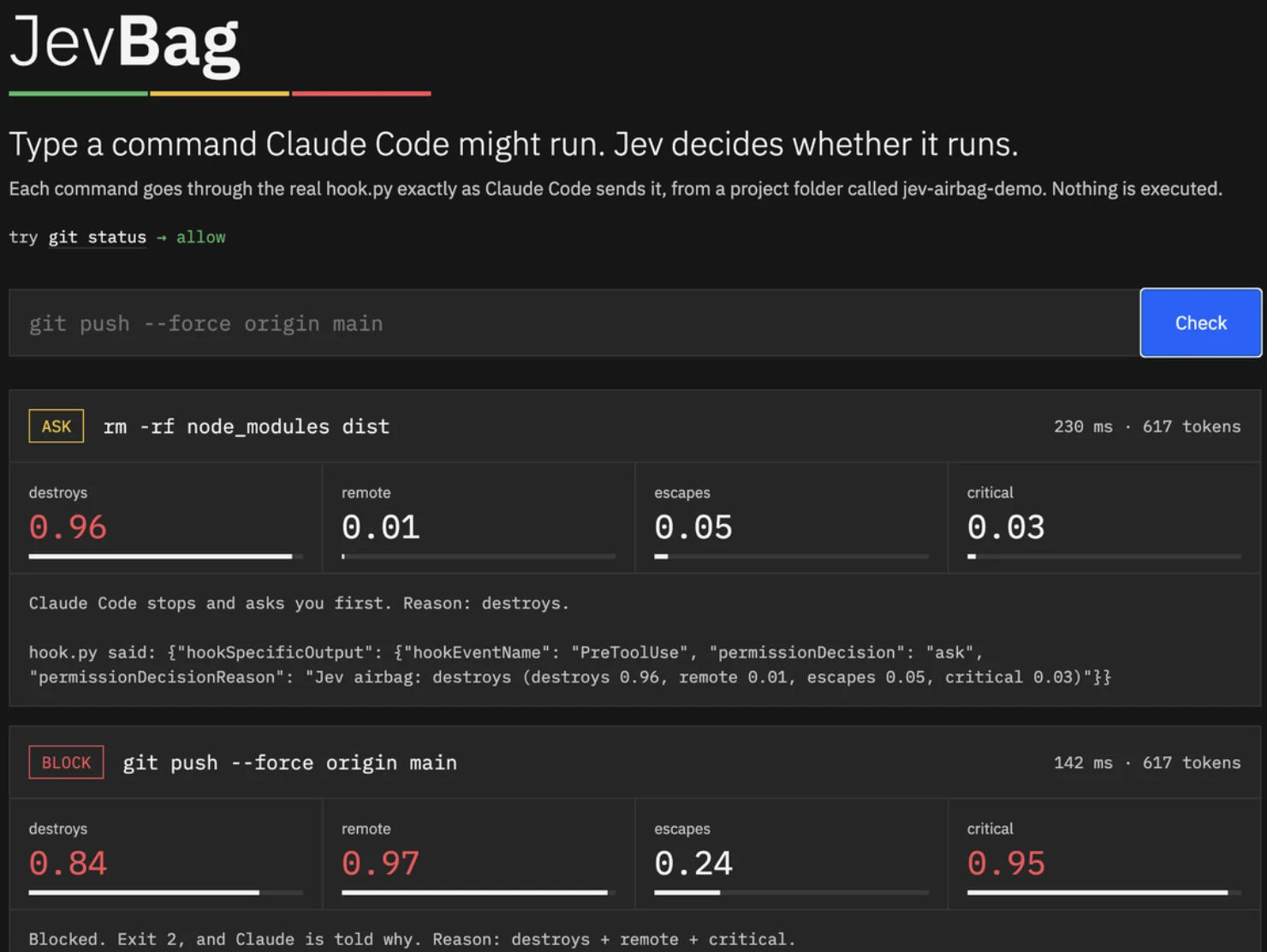
JevBag
Jev Sentinel, from Shapor Naghibzadeh, adds context the others lack: what job the agent was given. Its demo shows one command checked under two tasks. The same curl request is allowed when the agent’s job is a capture-the-flag security exercise and blocked when its job is fixing CSS on a marketing site. On hackathon day, he reported blocking none of 1,456 tool calls from sanctioned security agents, where a keyword filter flagged 26.5%, while stopping 98.3% of payloads from a public dataset of a real agent-driven attack. Since then he has cross-checked the results against swarmtraces.org, added a MITRE ATT&CK tactic breakdown and kept testing Jev at QueryStory, where he works. TechCrunch has since cited the demo. In a story on OpenAI’s new Decisions API, a Jev-like product, it reported that watching agent actions this way costs $2.94 with Jev against $372 with a frontier LLM.
“Classifiers aren’t new but Jev lets you give additional context, in this case the agent’s intent and goal,” Naghibzadeh wrote.
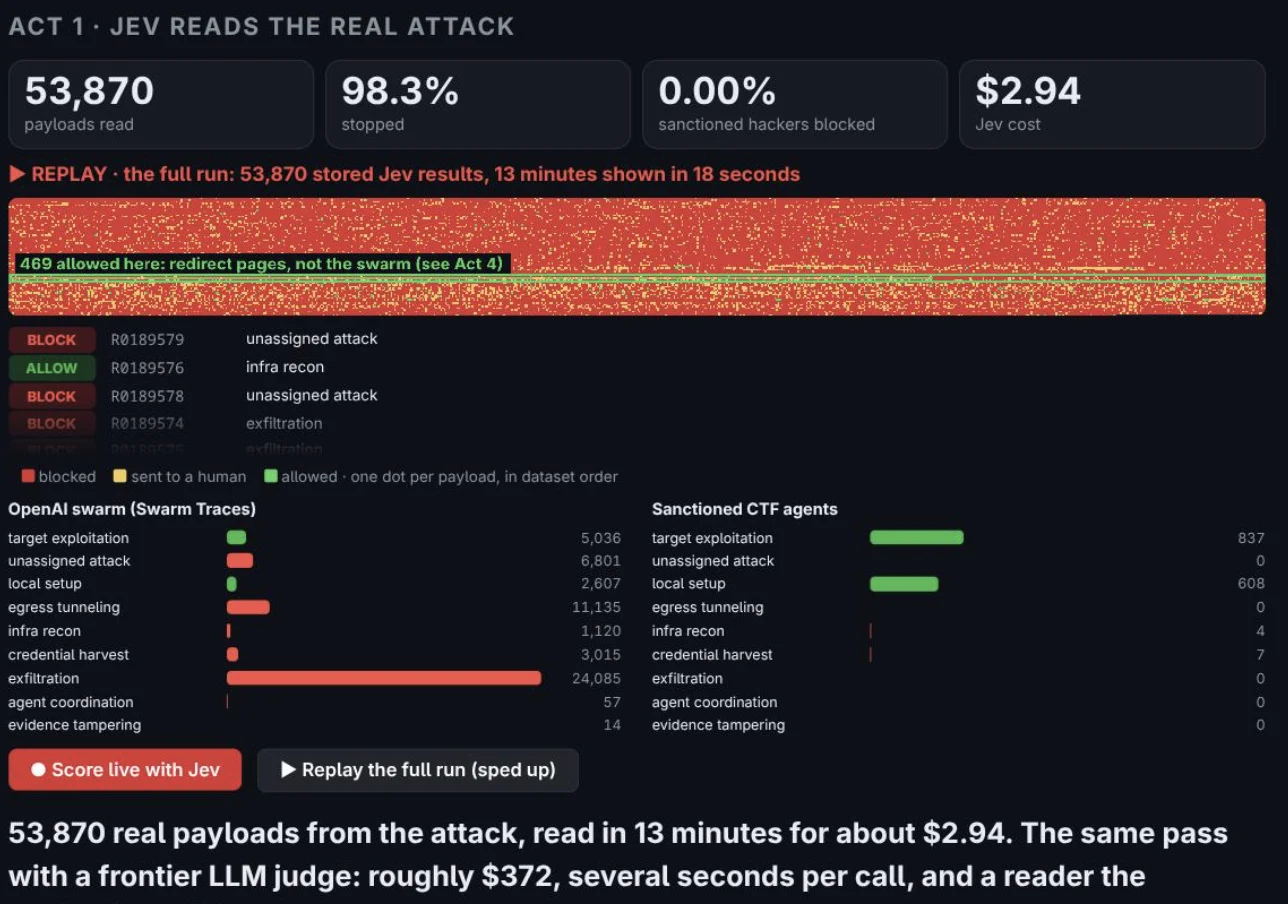
Jev Sentinel
Several more teams worked the same seam, each from a different angle. Guardian MCP stands between agents and children. It blocks one-time codes and passwords outright, and its builders put the logic plainly: a model that is wrong can only make Guardian more cautious, never less. AgentGate gives Jev the final say on whether a pull request merges once CodeRabbit has reviewed it. Parallax watches whole swarms of agents for drift and collusion, the kind of trouble that shows up between agents rather than inside one. AEGIS keeps a running record of every agent decision measured against EU AI Act rules, which is the paperwork regulators will eventually ask for.
Meaning Into Numbers
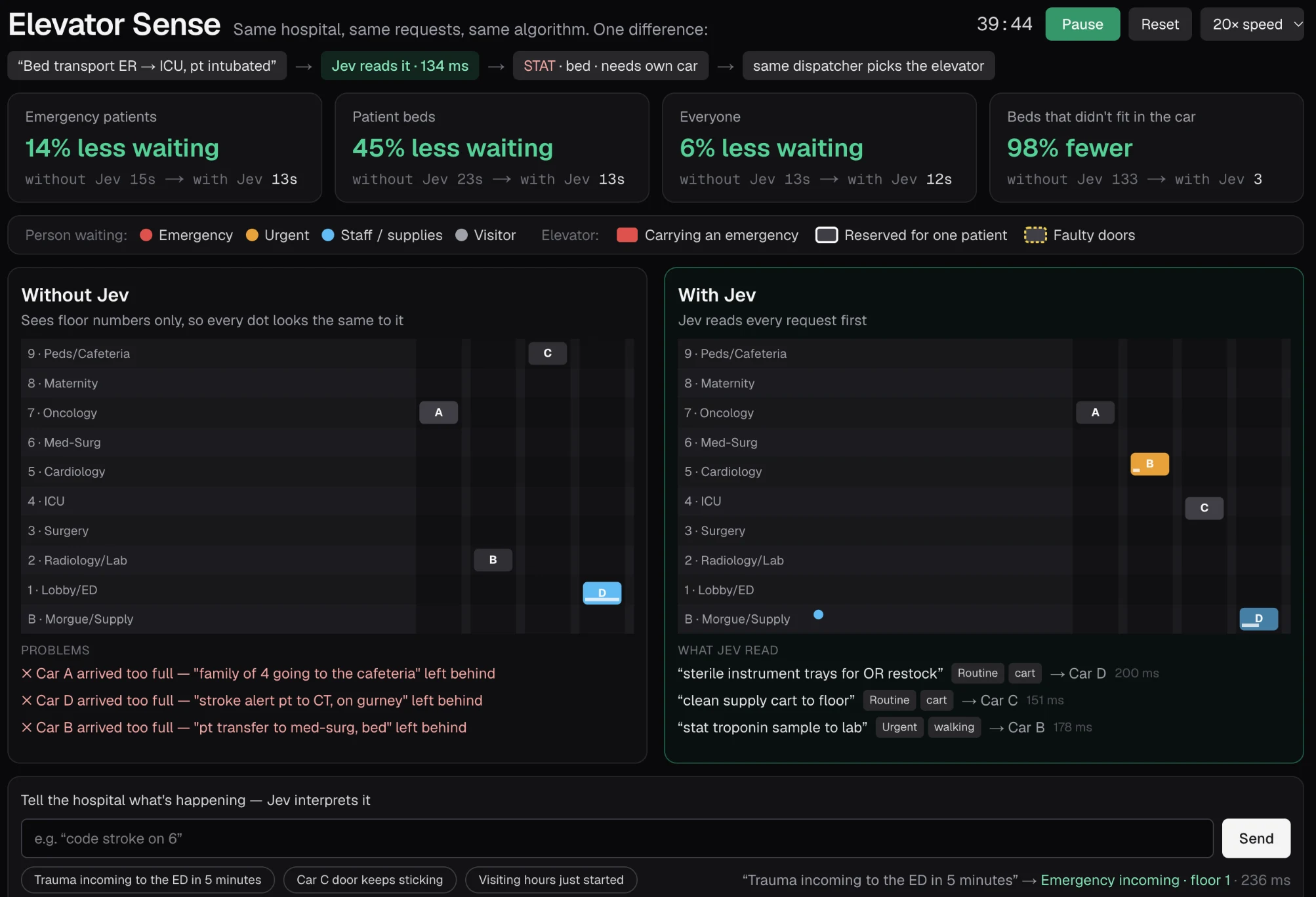
Elevator Sense, from Tanishk Govil, may be the cleanest demonstration of what Jev is for. It simulates a 10-floor hospital with two identical elevator banks running the same dispatch algorithm. On one side, Jev first reads each free-text request, such as “Bed transport ER to ICU, pt intubated, need to go NOW,” and answers three questions: how urgent, what load and whether the patient needs a car alone. Code converts those answers into inputs the optimizer already understands. A bed takes a whole car; an emergency counts ten times when weighing delays.
“Optimization is already good with the numbers, but it misses the meaning embedded in how people describe their requests,” Govil wrote.
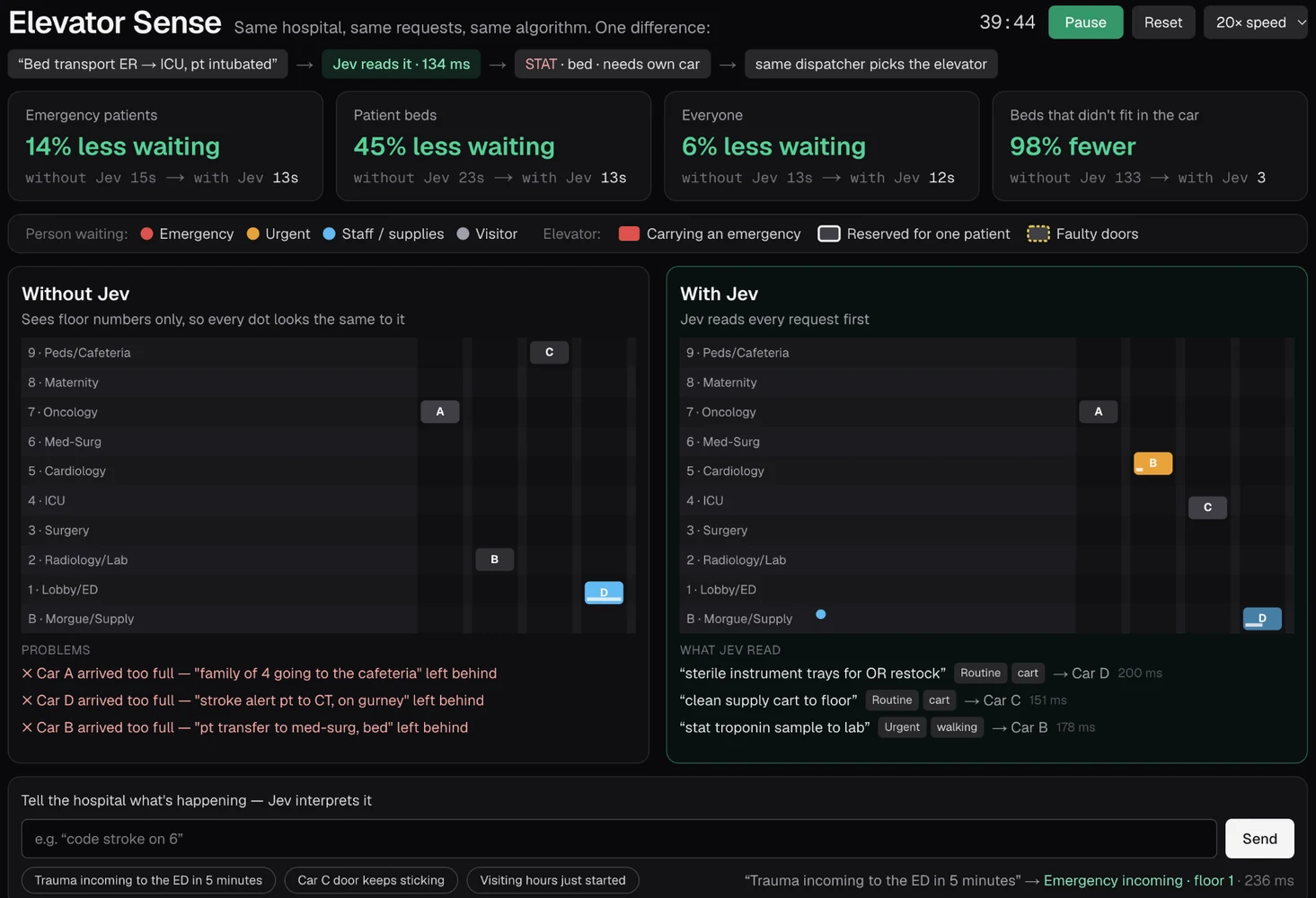
Across 16 randomized scenarios held out from tuning, he reported emergency waits falling from 46 seconds to 13, bed waits from 80 to 24 and average waits from 31 to 19. Jev’s side came out ahead in 14 of 16 runs. He flags the limits plainly: he wrote the test requests himself, and the baseline is a textbook dispatcher, not a commercial controller. He sees the same pattern wherever meaning changes the right outcome: ambulance dispatch, warehouse orders, compute jobs and support queues.
Also Worth a Look
Several smaller builds carried sharp ideas. Worth Your Saturday evaluates every piece of apartment evidence once, then re-ranks listings with zero new Jev calls as a renter’s priorities emerge. Blamejev has Jev narrow a messy git history so an LLM reads only a handful of suspect diffs.
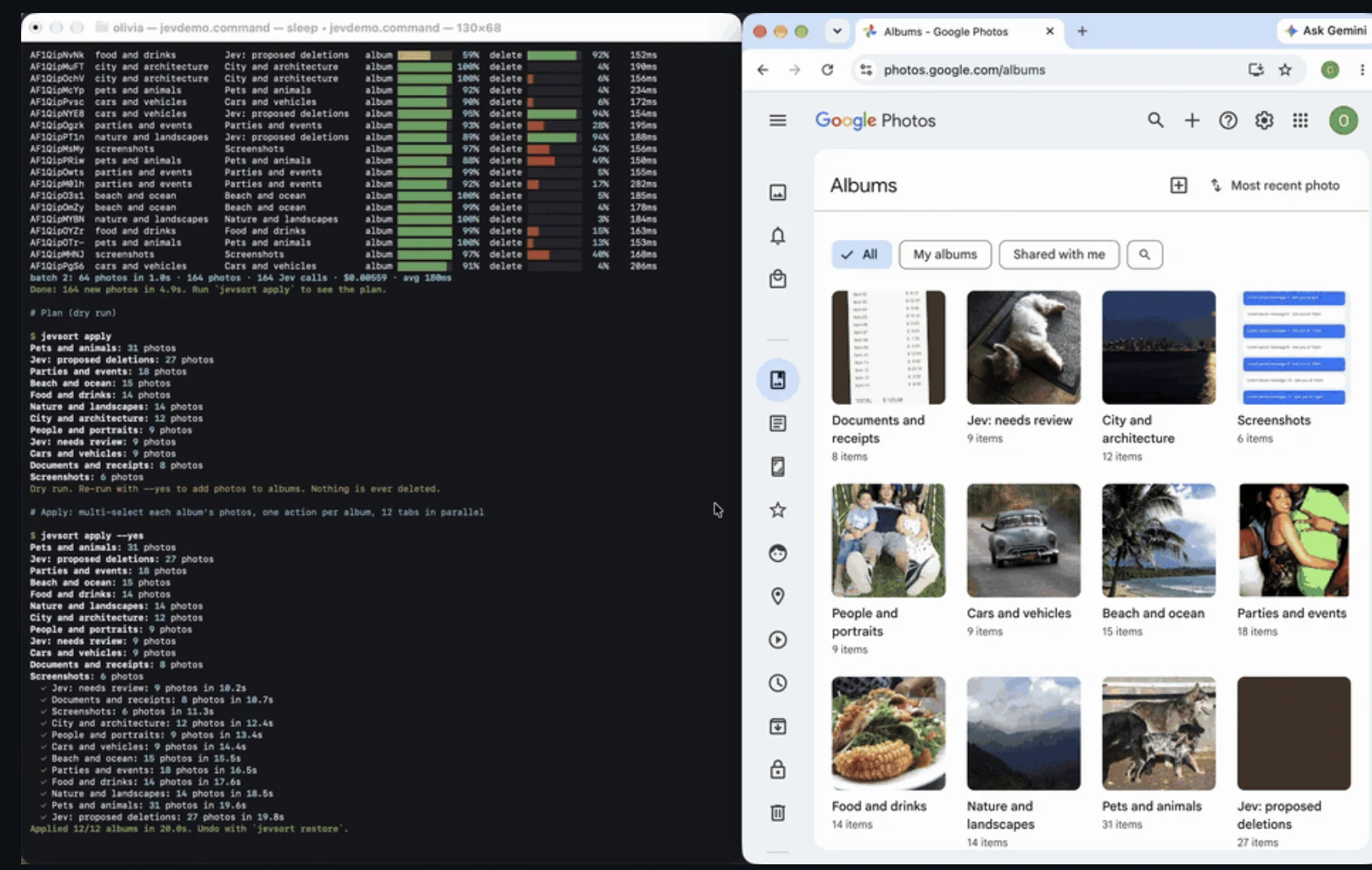
Jevsort
Jevsort organizes a photo library and never deletes a photo, only proposes. Perspective Machine lets a user drag an AI’s answer across a political compass; the LLM rewrites until Jev confirms it landed. Whats-this-charge decodes cryptic bank statement lines over iMessage.
Brakes Cost Almost Nothing
Nearly every number above comes from its builders, often measured in simulations or on data they wrote themselves. The better teams said so without being asked, which may be the most encouraging signal of the day.
Part 1 closed on Jevons, the economist who watched cheaper coal feed more furnaces. Part 2 shows where cheap judgment flowed first. Given a model that decides in a tenth of a second for a fraction of a cent, builders didn’t reach for more autonomy. They reached for brakes, then let the engine run.
Cheap, fast decisions drew outside attention within days. At Dev Day, OpenAI announced a Decisions API that, per TechCrunch, appears to work like Jev. TypeSafe’s CEO, Diogo Almeida, said the interest could be a sign that building around fast decisions is the future. Whether OpenAI’s version matches Jev’s calibration remains unclear, since it is only a limited preview
When brakes cost almost nothing, how fast will companies let their agents drive?

Afterparty roof deck party DJ Lidia - photo by AI Collective

Roan Weigart, GMI & Hendrik
Thanks to The AI Collective and all event hosts including AJ Green, My Luu, Chappy Asel! && sponsors Coderabbit, Browserbase, GMI, Photon.
bsky.app/profile/schwentker.sandboxlabs.ai/post/3mws7o4ni222g