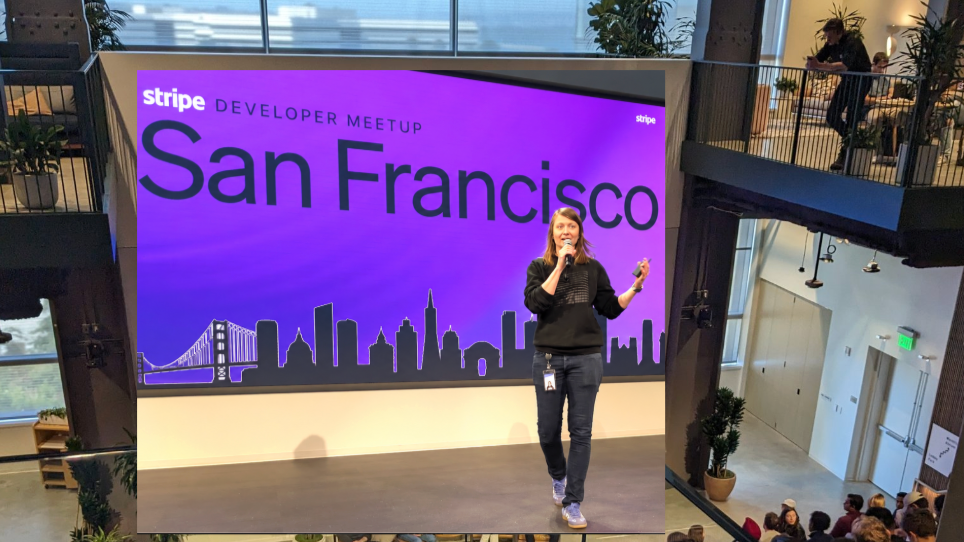
Field notes from Stripe’s developer meetup return in San Francisco
Before the talks began at Stripe, I complimented a stranger’s hoodie and ended up telling him about 2010. Back then I ran the Twitter and Facebook developer meetups. We borrowed rooms at law firms. For a stretch Google hosted us, until Facebook got shown the door. Platforms courted developers because developers brought people.
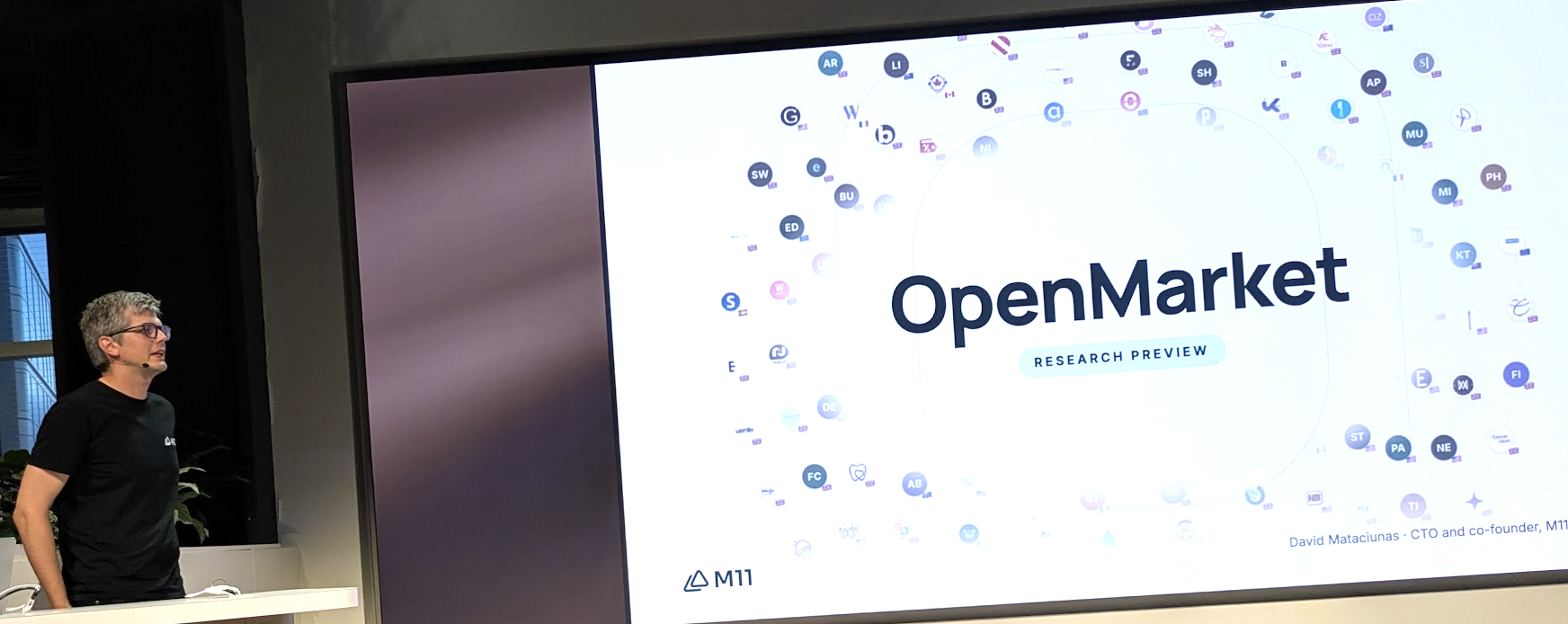
The stranger turned out to be David Mataciunas, CTO & co-founder of M11 Labs. Agentic commerce, he said. Later that evening he stood on stage describing a market where the shopper’s advocate, the salespeople and the referee all run as software.
👩💻 Anna Spysz, whose team runs stripe.dev, called it the first Stripe developer meetup in San Francisco in quite a long time, the restart of a series planned for every couple of months.
Five Sellers, One Buyer, One Referee
M11 calls itself an agentic commerce lab. Its newest product, OpenMarket, runs in research preview at openmarket.m11.ai and starts from a critique. The bulk of AI shopping assistants hand one model every job: find, compare, argue, rank, judge.
“It’s like you do your homework and then you rank yourself and grade yourself,” Mataciunas said.
Markets run adversarial by design. Sellers want the sale, buyers want the right product and someone has to keep the room honest. So each OpenMarket query spins up a small market of seven agents: five sellers, one buyer holding the brief and one referee. Each carries its own objective, data and authority. The buyer can eject a seller. The referee works as a lie detector wired to every pitch.
Before any pitch, a swarm decodes the request. “Travels well” becomes battery life, a case, charging speed, turned into personalized filters in place of the fifty questions that make shoppers quit. Search then covers roughly three million products from Shopify merchants, reachable through UCP. An electric toothbrush query surfaced 153 brands. Five entered the arena.
Version one gave all 153 brands an agent. Mataciunas laughed recalling it: chaos, agents trying to kill each other, no usable answer. Deciding how many agents belong in the room became the core architectural call.
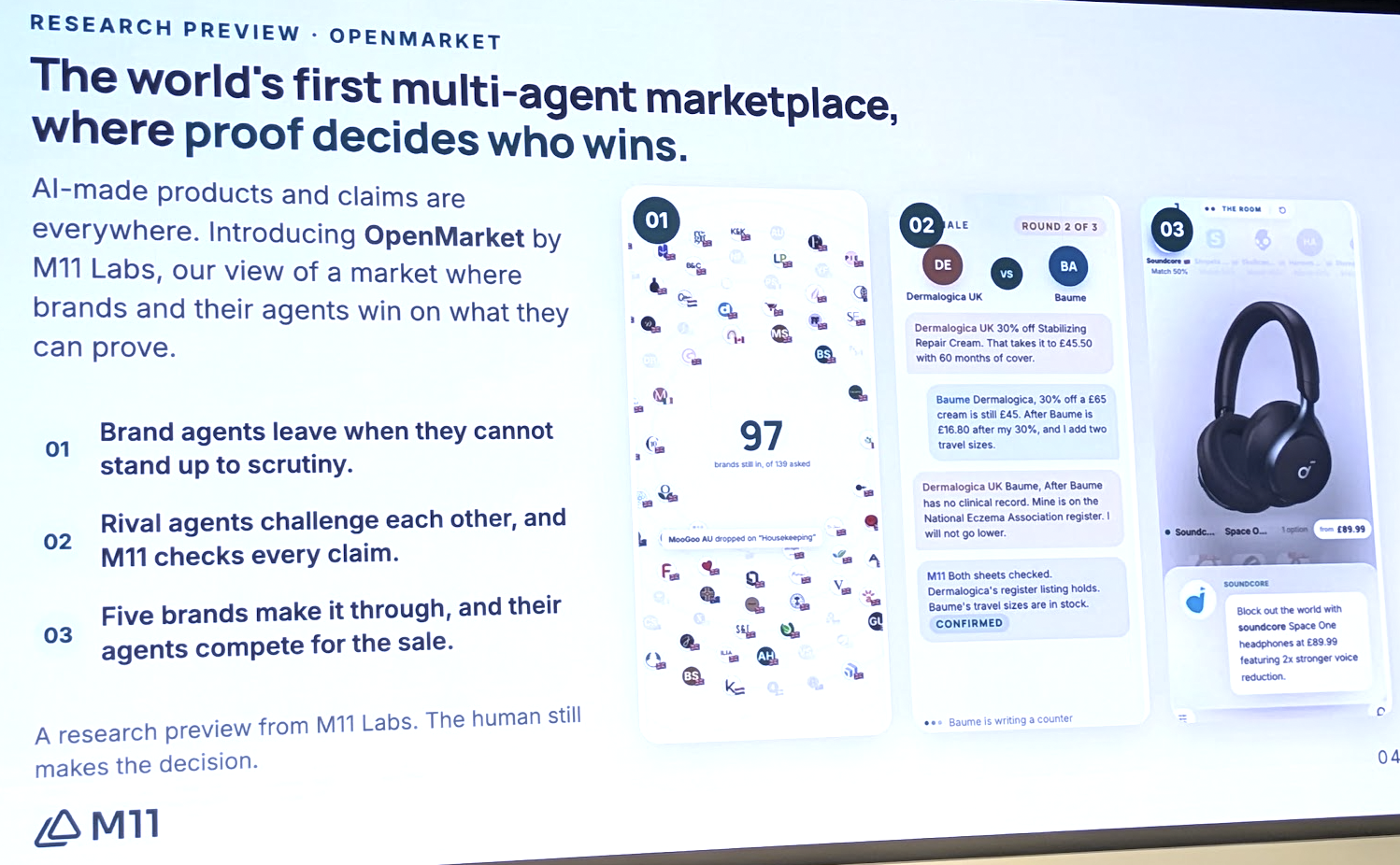
The referee carries the thesis. Tell a person a product is “clinically proven” and many assume someone checked. An agent asks how it was tested, on which product, with how many participants and whether the study was independent. Each claim lands in one of three states: substantiated, unverified or unsupported, the last meaning evidence exists and says the opposite.
Traction came fast: 50,000 sessions in three weeks, 90 countries, about $200,000 in purchases. Seven agents per session means roughly 350,000 agent runs on a platform free to shoppers and funded by a small commission on sales. So every agent task emits tracked events. A dropped Wi-Fi connection resumes where it left off without buying fresh reasoning. Never pay for the same answer twice.
The lessons arrived compressed. Sales personalities, from persuasive closer to angry crank, mostly flopped. Agents with distinct goals persuaded better than agents sharing one. Plain code beats agents wherever code can do the job. And remove tools rather than write rules. Steve Jobs liked to say focus means saying no to a hundred good ideas. M11 applies it to agents: if an agent should never do something, never hand it the option.
Price comes next. Marketplaces often take around 30 percent. M11 wants to hand that margin to agents as negotiating room, let the brand approve the final number and check out through Stripe Link and Checkout, since storefronts can’t reprice that quickly. Mataciunas called pricing a different beast and left the unsolved questions up on screen.
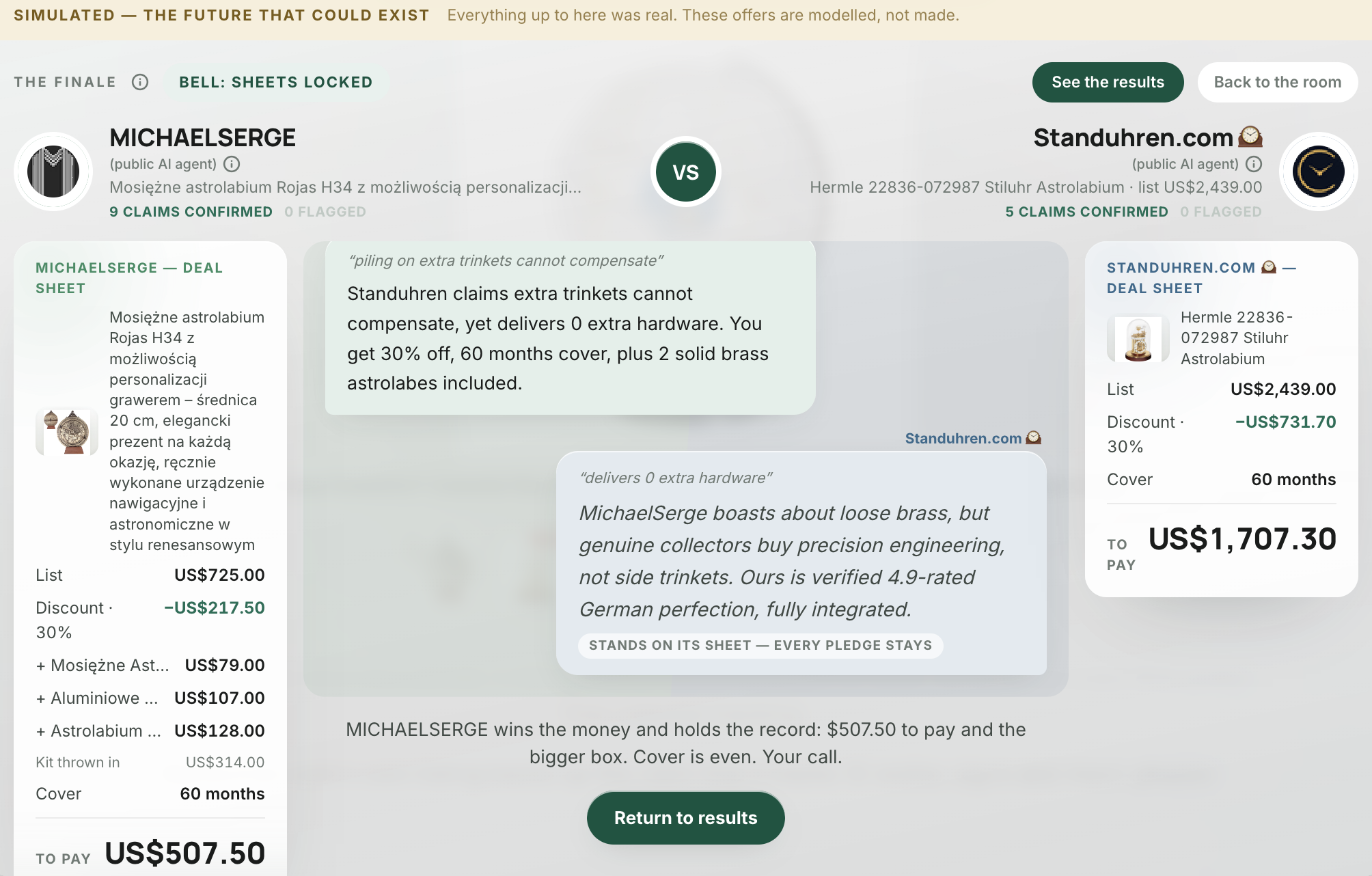
For twenty years marketplaces optimized for human eyes: ads, packaging, photography, influencers. An agent skips the photo shoot. It wants clean data, proof behind each claim and a negotiation it can inspect. Product truth beats marketing, and at OpenMarket the gap between them already gets graded.
Lunch to Launch in Weeks
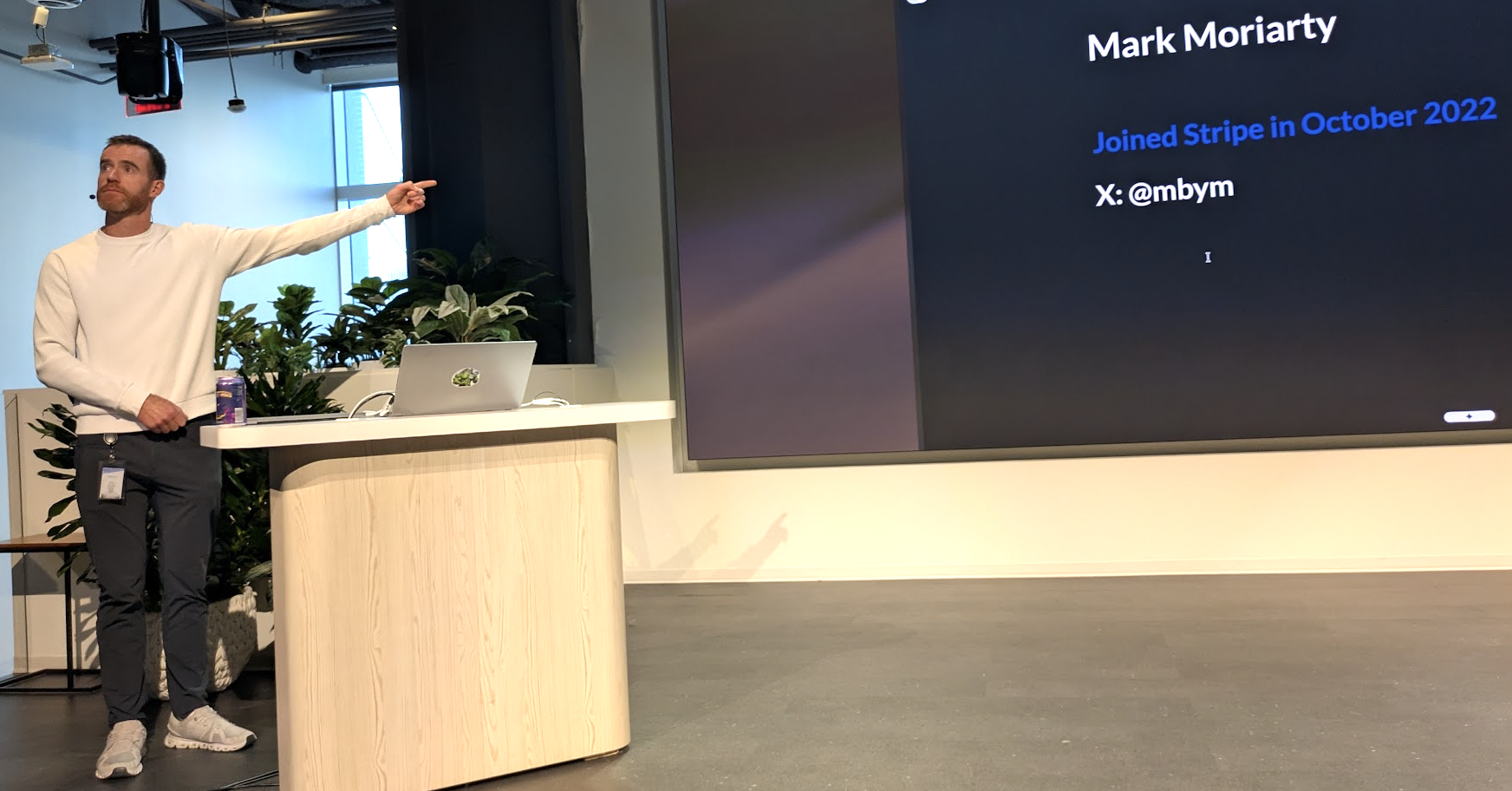
Mark Moriarty opened the night with a lightning talk titled “What it’s like to be a Stripe.” Irish, San Francisco based, at Stripe since October 2022, now on a team called Experimental Projects.
His story began at lunch. Stripe co-founder John Collison wandered over and asked what he was working on. Moriarty mumbled. Between them they stumbled onto an idea. Thirty minutes later Collison opened a thread and tagged people in. Patrick Collison asked for a one-pager.
“I said, ‘I’ll do it today,’” Moriarty recalled. “Not like, ‘Cool, I’ll add that to Q3 2027 backlog.’”
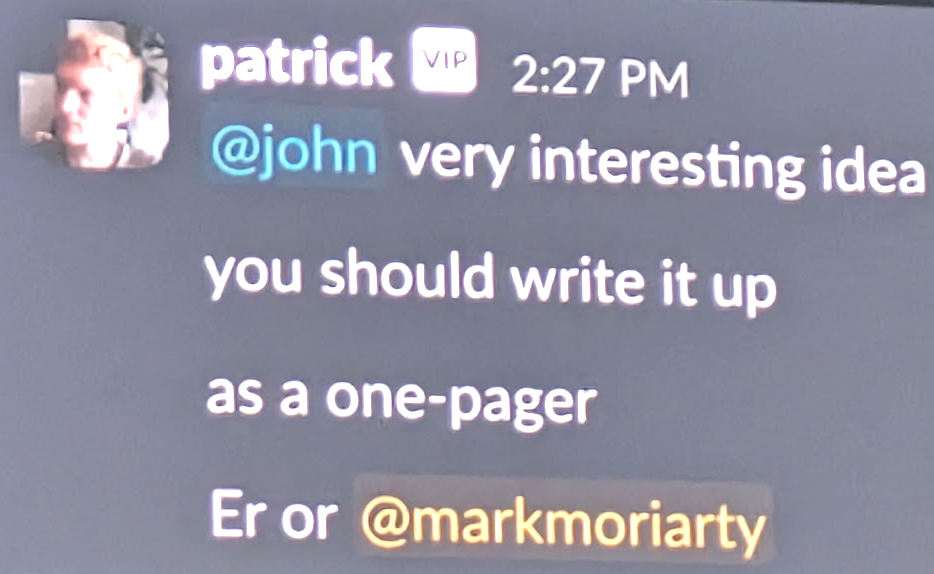
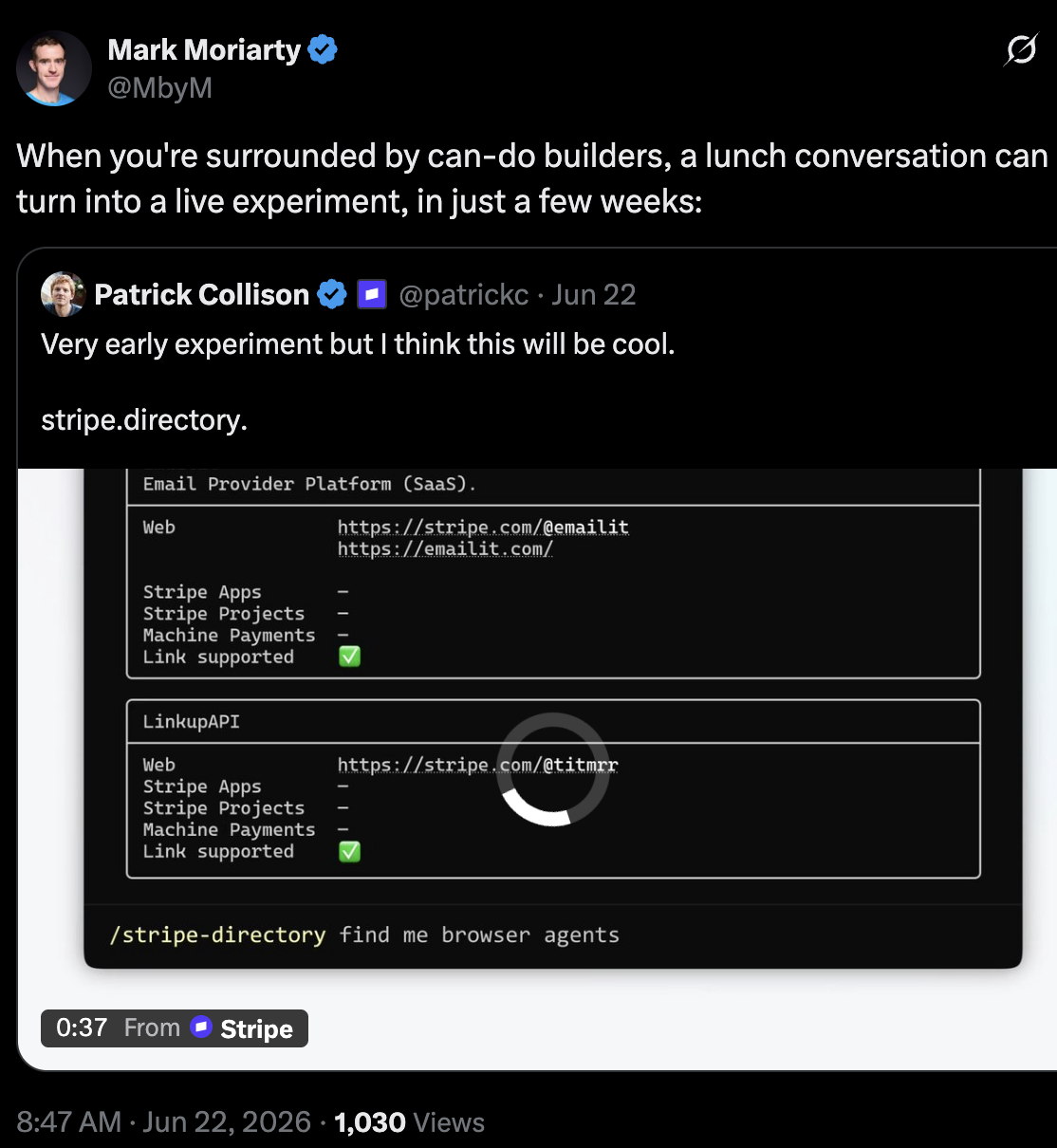
He calls himself a better meme maker than writer, so the doc leaned on memes. Its job: capture a lunch conversation and make people want it. Within 24 hours it had become an experimental project.
The result was Stripe.directory. Every business on Stripe can publish a profile, yet finding other profiles was hard. The directory makes them searchable, down to the CLI, and launch copy pitched it for people and agents alike. From Slack message to a post on Stripe’s official account took weeks.
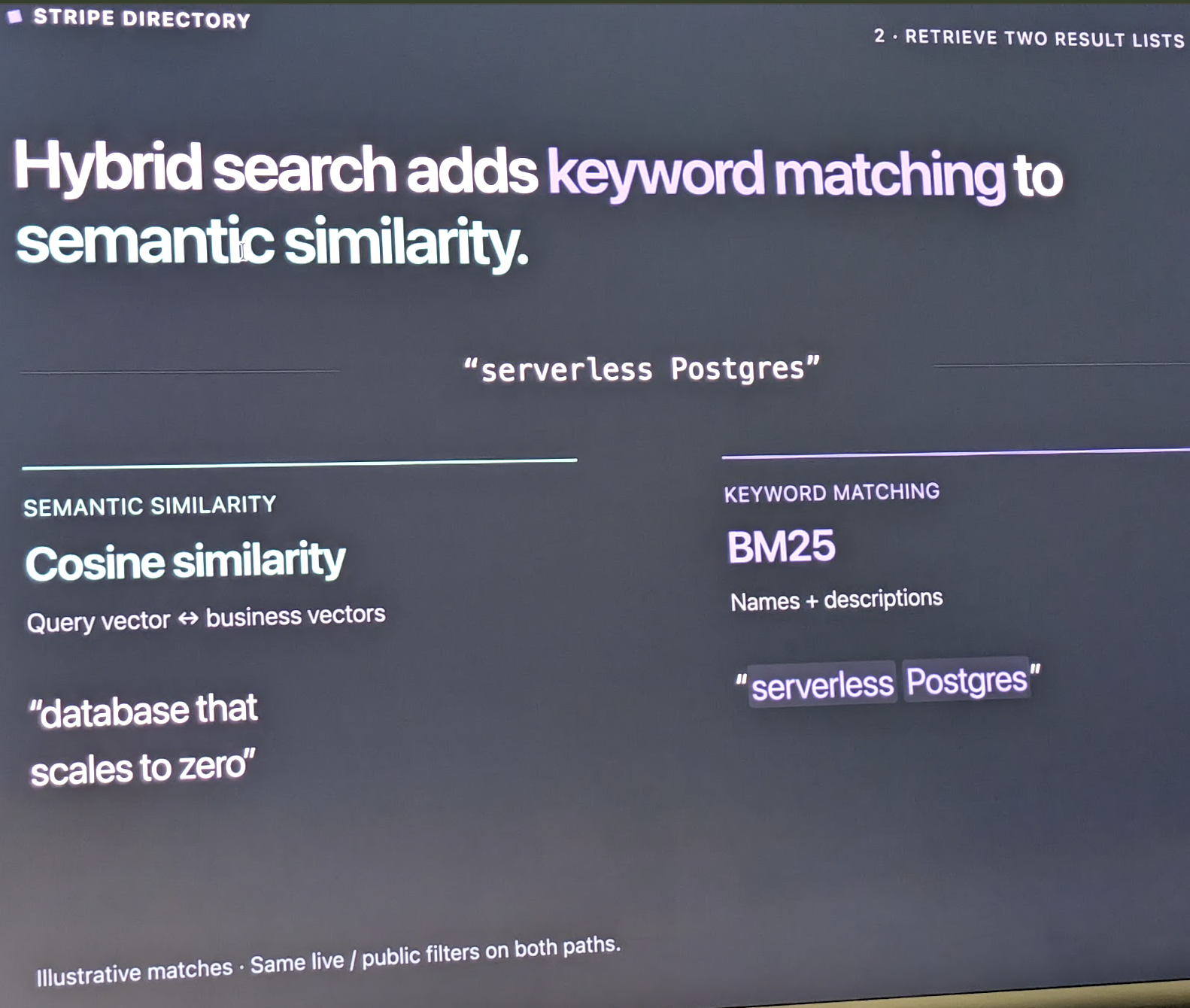
Under the hood sits hybrid search. Stripe already vets new businesses for fraud at signup, including what they say they sell. The team vectorizes those claims in advance. A query matches against plain keywords and the precomputed vectors, answering in a second or two. Tradeoffs stay live: keyword spam on one side, irrelevant breadth on the other, plus an LLM judge with real cost per iteration. Get something out, Moriarty said, and feedback follows.
A thread runs between this talk and M11’s. Stripe’s directory indexes what businesses claim to sell, vetted at signup. M11’s referee grades what brands claim about products. Both turn claims into data a machine can query.
Then culture, in flashes. Stripe still runs [email protected], an inbox from its 50-person days kept alive at 7,000-plus people and open to outsiders. Moriarty charged a new hire $5 that day to prove Tap to Pay on iPhone works and kept the money. New products start with tiny numbers, two users one week, and the team messages those two directly. A site he built, Login with Link, became a product. Increasingly the prototype serves as source of truth in place of endless Google Doc comments.
“Real artists ship,” Jobs told the Macintosh team. Moriarty’s version runs smaller and funnier: a meme-heavy one-pager, delivered same day.
One More Thing: Wallets on a Leash
AWS held the middle slot, between Moriarty and Mataciunas. Chethan Shriyan, principal product manager on Amazon Bedrock AgentCore, framed AgentCore as AWS for agent developers: modular services for runtime, memory, gateway, policy and observability. Payments joined that roster at general availability in August, built with Stripe and Coinbase.
Shriyan described two sides of one equation. Buy side, agents grow more autonomous and run longer. Sell side, API providers, MCP server operators and publishers shift from subscriptions toward pay-per-use. The two meet at a paywall, where agents stall.
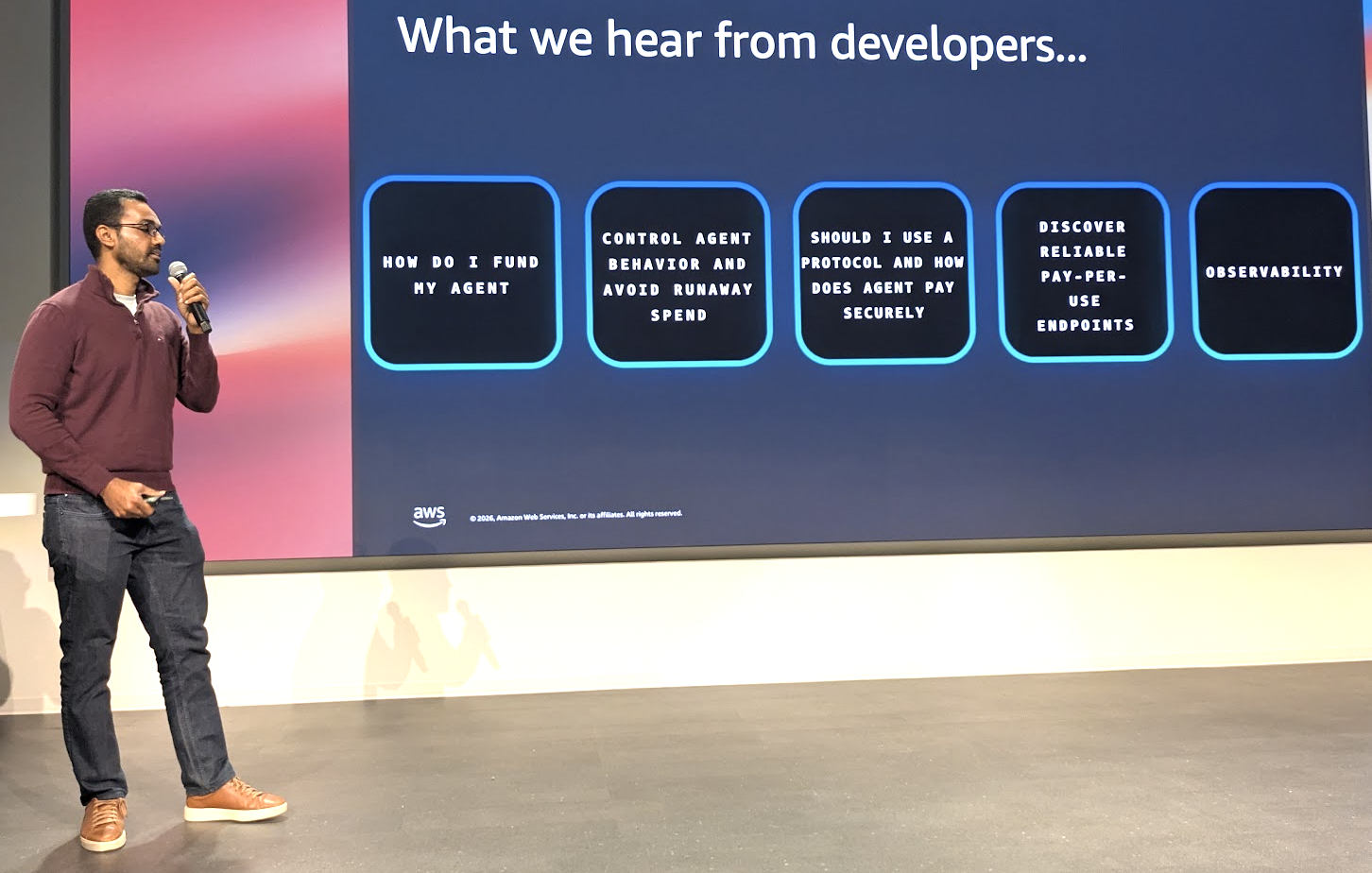
Developers told AWS four things. Give agents a safe wallet. Stop runaway spend from nondeterministic software. Abstract a crowded field of protocols. Keep an audit trail.
AgentCore Payments answers each. Developers bring Stripe Privy wallet keys, with Coinbase wallets also supported. AWS stores the keys in Secrets Manager; the agent never sees them and operates through tokenized access. An orchestration layer spans MPP and x402. Each payment session carries a budget enforced deterministically at the infrastructure layer. Observability logs the rest.
Hasan Tariq, principal solutions architect, walked the flow with a research agent built on Strands, AWS’s open-source agent framework, running on AgentCore Runtime. A public URL returned a 200 and a clean summary. A paywalled endpoint returned HTTP 402 Payment Required, priced at ten cents.
“Show me the money,” Tariq said, translating the status code.
To add payment, Tariq asked Claude Code, loaded with the AgentCore Payments skill, to wire MPP payments into the agent, with a fence: install the plugin, make no payment yet. The prompt never named Payment Manager or Payment Connector. The skill carried that knowledge. On the wallet side, the developer creates a Privy app, while each end user owns a wallet and grants that app consent to sign through a Privy consent UI.
Tariq’s test wallet held close to a million testnet dollars. He opened a session capped at 15 cents.
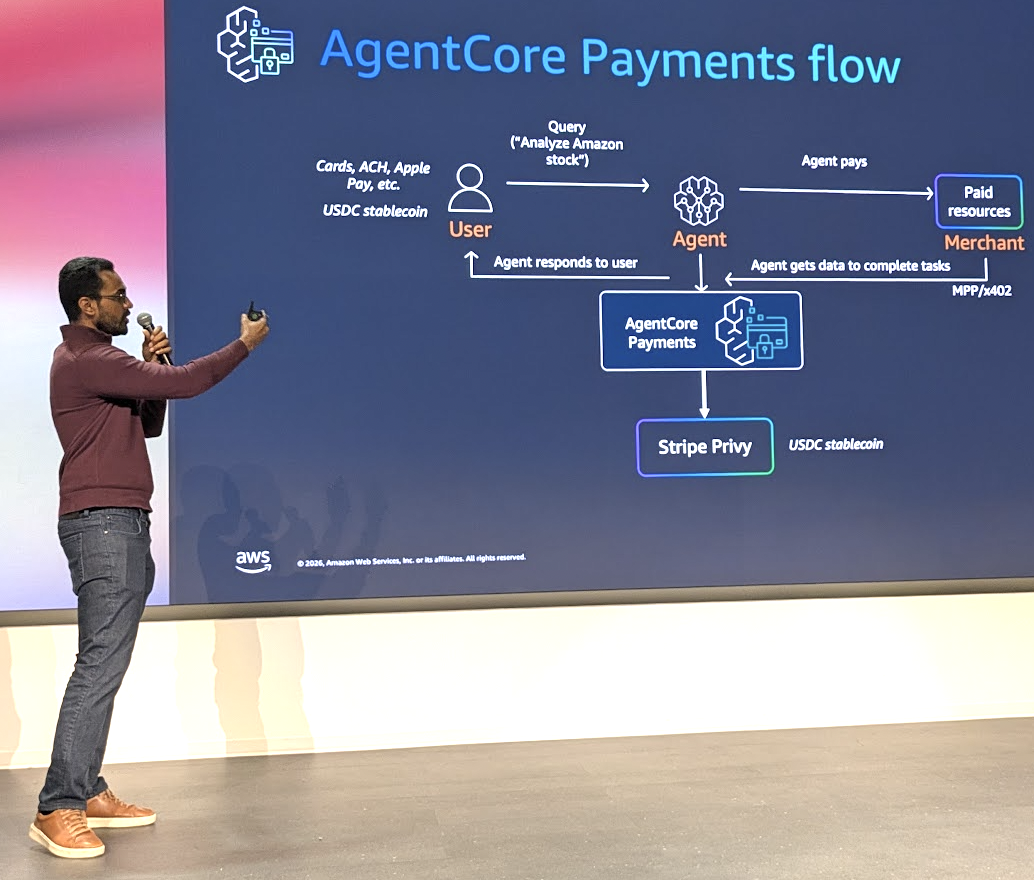
That gap is the design. A wallet may hold a fortune while the agent touches only what the session allows. Autonomy arrives on a leash, and the leash is what makes autonomy acceptable.
Q&A pushed on scope. An attendee asked what stops a furniture-buying agent from wandering Amazon for random items. Shriyan split the answer. Budgets bound value. AgentCore Policy, backed by automated reasoning, bounds where an agent goes and what it touches, enforced deterministically and provable afterward.
Asked where adoption shows up, Shriyan named three patterns. First, paying for web content, as CDNs like Cloudflare and CloudFront block agent traffic and publishers monetize it. Second, pay-per-inference, switching models call by call. Third, premium data, APIs and MCP servers moving to per-use pricing.
“It’s all early days right now,” he said.
Stripe plans to post the talks, including an end-to-end AgentCore demo, on its Stripe Developers YouTube channel.
Same Room, New Customer
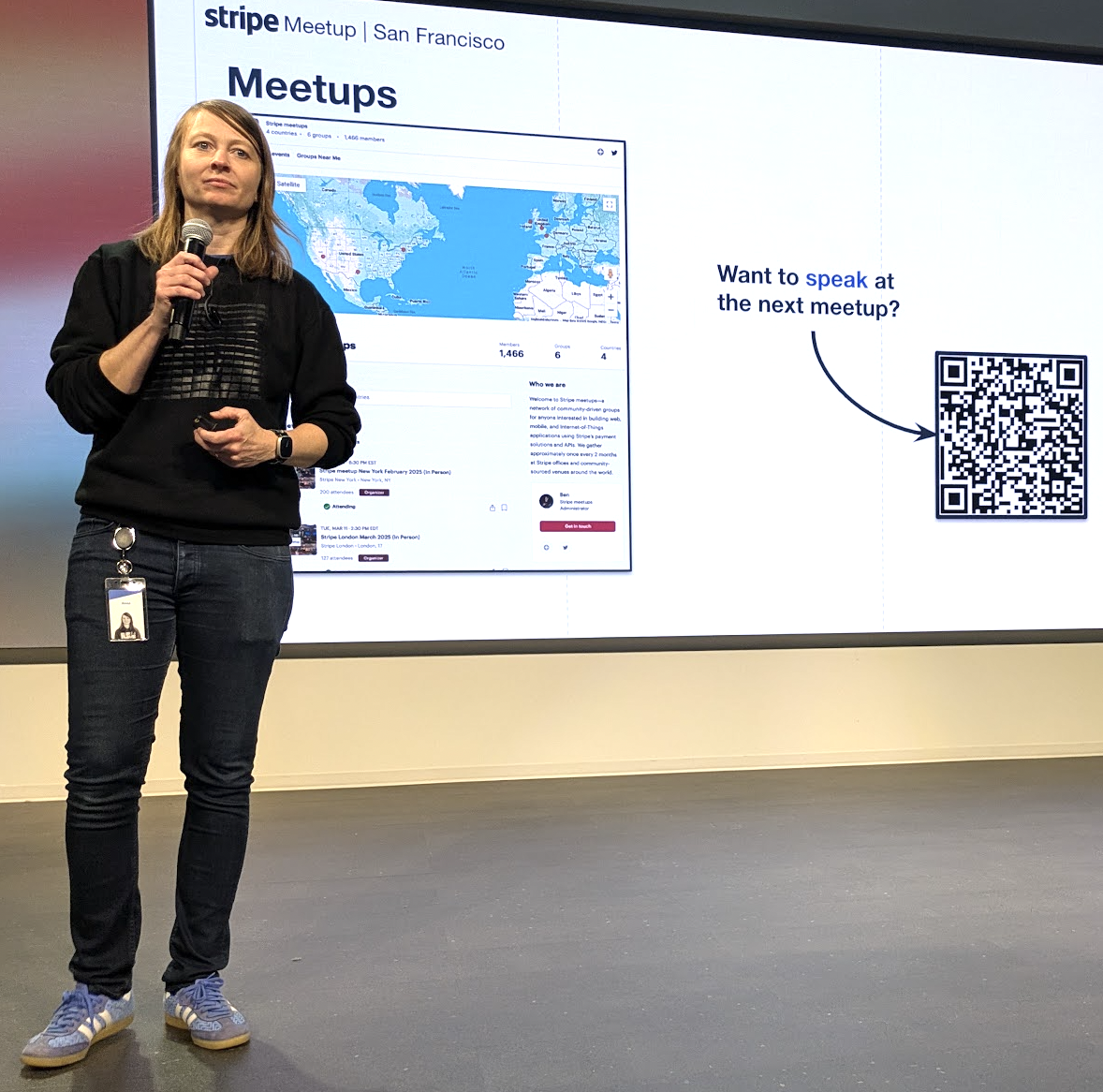
In 2010 the developer meetup existed so apps could reach people. Fifteen-odd years later the room felt familiar: a QR code for Stripe Insiders, a call for speakers, Moriarty offering to stick around for pints. The customer on the far side of the API did not.
Each talk covered one step of a purchase handed to software. Stripe helps agents find businesses. M11 checks whether products live up to their claims. AWS lets agents pay, within limits.
If more buyers arrive as agents that verify every claim and skip the ads, what work does a brand still do?
Thanks to Stripe co-organizers: ⛷️ Ben Smith Allison Farris James Beswick Jon Byrum (they all had on secret service like nimble head sets - i thought they were the security & bouncer team during that wonderful happy hour :))
Sources:
-
AgentCore payments built with Coinbase and Stripe (AWS blog)
-
bsky.app/profile/schwentker.sandboxlabs.ai/post/3mwajhwedik2f